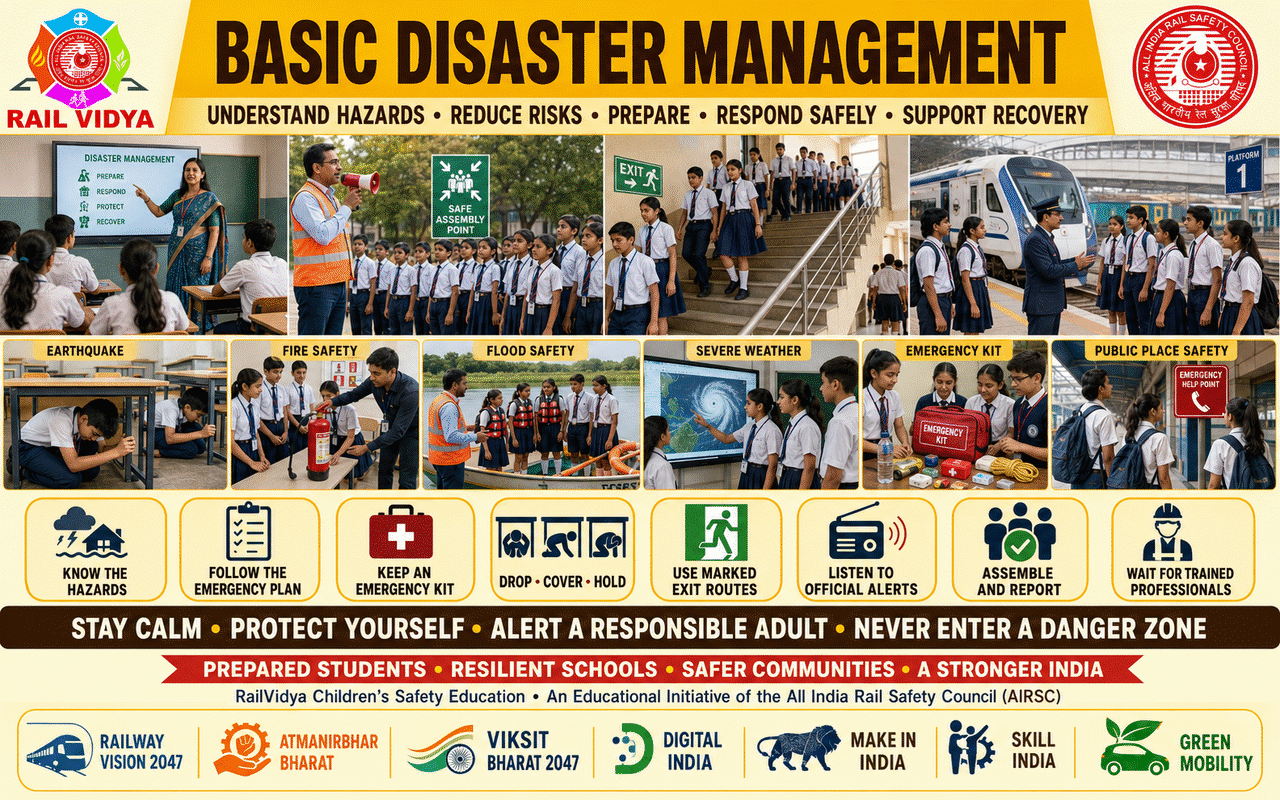
Basic Disaster Management equips students with the awareness and practical knowledge needed to identify hazards, reduce risks, prepare for emergencies, respond calmly and support safe recovery. Through RailVidya, children learn to follow emergency plans, participate seriously in drills, trust verified instructions, report dangers and assist only within safe limits—helping build safer schools, resilient communities and a disaster-prepared India.
Basic Disaster Management
Basic disaster management is the organised process of understanding hazards, reducing risks, preparing for emergencies, responding safely and supporting recovery after a disaster. For children and young people, disaster-management education is an essential life skill that develops awareness, preparedness, discipline and confidence. It helps students understand that although every disaster cannot be prevented, timely planning and responsible action can significantly reduce injury, loss of life and damage to property.
A disaster may arise from natural hazards such as earthquakes, floods, cyclones, landslides, lightning, heatwaves, severe storms and forest fires. It may also result from human-caused or technological incidents, including building fires, chemical leaks, electrical accidents, transport emergencies, structural failures and industrial hazards. A dangerous event becomes a major disaster when it overwhelms the ability of people or institutions to manage its consequences effectively.
Disaster management should not begin only after an emergency occurs. It is a continuous cycle consisting of four closely connected stages: prevention and mitigation, preparedness, response and recovery. Prevention and mitigation aim to eliminate hazards or reduce their possible impact. Preparedness ensures that people know what to do before an emergency. Response involves immediate actions to protect life and meet urgent needs. Recovery focuses on restoring normal life, rebuilding safely and supporting affected individuals and communities.
Understanding Hazards, Risks and Vulnerability
A hazard is an event or condition capable of causing harm, while risk is the possibility that the hazard may affect people, property or the environment. Vulnerability refers to conditions that make individuals or communities more likely to suffer harm. Children, elderly persons, persons with disabilities, individuals with medical needs and people unfamiliar with emergency procedures may require additional assistance during a disaster.
Students should learn to identify hazards in their homes, schools and neighbourhoods. Blocked exits, damaged electrical wiring, unstable furniture, unsafe buildings, overflowing drains, unprotected water bodies, combustible materials and overcrowded passages can increase disaster risk. Recognising and reporting such conditions before an emergency is an important part of prevention.
Prevention and Risk Reduction
Disaster risk reduction begins with responsible planning and safe everyday practices. Buildings should follow applicable safety standards, emergency exits must remain accessible, electrical systems should be maintained and fire-safety equipment must be regularly inspected. Heavy furniture and equipment should be secured, hazardous materials stored responsibly and school transport systems maintained properly.
Students can contribute by keeping corridors and exits clear, reporting hazards, protecting safety equipment, conserving the environment and following institutional safety rules. They should understand that damaging alarms, blocking evacuation routes, spreading false warnings or misusing emergency equipment can endanger the entire community.
Environmental responsibility also supports disaster prevention. Protecting trees, avoiding the obstruction of drains, conserving water, managing waste correctly and respecting natural drainage systems can help reduce certain local risks. Disaster safety is therefore connected with environmental awareness, responsible development and community discipline.
Preparedness Before a Disaster
Preparedness means developing the knowledge, plans, resources and practical skills required before an emergency occurs. Every family and school should have a clear emergency plan. Students should know the safest exits, evacuation routes, assembly areas, emergency contact procedures and the adults responsible for giving instructions.
Schools should display evacuation maps prominently and make reasonable arrangements for children with disabilities or additional support needs. Emergency plans should identify alternative exits in case the primary route becomes unsafe. Contact information for parents, guardians, medical services, police, fire services and local disaster-management authorities should be maintained and updated.
Families should discuss where members will meet if they become separated and identify a trusted person who may be contacted during an emergency. Children should learn important telephone numbers and their home address but must protect this information from unnecessary public or online disclosure.
A basic family or school emergency kit may contain safe drinking water, non-perishable food, a torch, spare batteries, a whistle, a first-aid kit, essential medicines, hygiene supplies, copies of important documents and necessary communication resources. Kits should be prepared and checked by responsible adults, kept in accessible locations and reviewed periodically.
Emergency Drills and Practical Learning
Emergency drills help transform written plans into practical ability. Fire, earthquake, evacuation and shelter-in-place exercises should be conducted periodically under trained supervision. Students must treat every drill seriously, remain calm, listen to instructions, move in an orderly manner and report to the designated assembly area.
During an evacuation, students should not run, push, return for personal belongings or use lifts unless specifically authorised. They should follow marked routes and remain with their assigned group. Teachers or authorised personnel should conduct attendance checks at the assembly point so that missing individuals can be identified promptly.
Drills must also be inclusive. Schools should ensure that younger children, persons with disabilities and students requiring medical or mobility assistance are supported through pre-arranged procedures. Students may assist others only when instructed and when doing so does not place them in danger.
Responding Safely During an Emergency
The first principle of disaster response is to remain calm and avoid impulsive action. Students should quickly observe the surroundings, recognise immediate dangers and follow the directions of teachers, parents, emergency personnel or authorised officials. They must never enter a hazardous area, touch fallen electrical wires, approach damaged structures or attempt a rescue beyond their training.
Emergency information should be obtained from official announcements, school authorities, government agencies or trusted news channels. Rumours, unverified social-media posts and frightening messages should not be forwarded. False information can create panic, obstruct emergency operations and place additional lives at risk.
When contacting emergency services, the caller should provide the exact location, type of emergency, number of people affected and details of any continuing hazard. In India, 112 may be used for integrated emergency assistance. The caller should listen carefully, answer questions clearly and follow the instructions provided.
Earthquake Safety
During an earthquake, students indoors should generally follow the recognised instruction to Drop, Cover and Hold On. They should move away from windows, glass, heavy objects and unstable furniture while protecting the head and neck. Running outside during strong shaking may expose them to falling materials.
After the shaking stops, students should follow authorised evacuation instructions and move carefully to an open assembly area. Lifts should not be used, and damaged buildings should not be re-entered until declared safe by competent authorities. Fallen electrical wires, gas leaks, broken glass and weakened structures must be reported and avoided.
Fire Safety
When smoke, flames or a fire alarm is noticed, students should immediately alert an adult and follow the established evacuation route. They should move quickly but without running or pushing. Lifts must not be used during a fire unless emergency authorities specifically direct otherwise.
Students should stay low if smoke affects visibility or breathing and should never hide in enclosed spaces. They must not return to a burning building to recover bags, mobile phones or other belongings. Fire extinguishers should be operated only by trained individuals when conditions permit and a safe escape route remains available.
If clothing catches fire, the individual should Stop, Drop and Roll while protecting the face. Burns require appropriate first aid and medical assessment. Children must never attempt to fight a large or rapidly spreading fire.
Flood and Heavy-Rain Safety
During floods or severe rainfall, students must move to a safer or higher location when instructed by authorities. They should never walk, swim, cycle or play in floodwater because its depth, current and contamination may not be visible. Open drains, damaged roads, live electrical wires and hidden debris can create serious danger.
Children must not attempt to cross water-covered roads, bridges, railway tracks or underpasses. They should remain with responsible adults, follow evacuation orders and use only authorised shelters and routes. Food or water that may have been contaminated should not be consumed without approval from responsible authorities.
Cyclone and Severe-Storm Safety
Before a cyclone or severe storm, doors and windows should be secured by responsible adults, loose outdoor objects should be removed and emergency supplies checked. Students should remain indoors or in an officially designated safe shelter and stay away from windows, glass doors and weak structures.
During the storm, official instructions should be followed continuously. Children should not go outside merely because conditions appear temporarily calm, as dangerous winds or rainfall may return. Coastal areas, damaged buildings, flooded locations and fallen electrical lines must be avoided after the event.
Lightning and Thunderstorm Safety
When thunder is heard or lightning is visible, students should promptly move inside a substantial building or enclosed vehicle. Open fields, rooftops, isolated trees, metal fences, water bodies and exposed high locations should be avoided.
Students should not gather beneath a single tree or touch electrical and plumbing systems unnecessarily during severe lightning conditions. Outdoor activities should resume only when authorised adults determine that conditions are safe.
Heatwave Safety
Heatwaves can cause dehydration, exhaustion and serious heat-related illness. Students should drink safe water regularly, wear suitable light clothing, reduce strenuous outdoor activity during the hottest periods and remain in shaded or cool environments whenever possible.
Warning signs such as dizziness, headache, weakness, nausea, confusion, fainting or unusually hot skin must be reported immediately. An affected person should be moved to a cooler location while medical assistance is obtained. Confusion, unconsciousness or severe symptoms require urgent professional care.
Chemical, Gas and Electrical Emergencies
During a chemical spill, gas leak or suspicious odour, students should avoid touching or approaching the substance and inform a responsible adult immediately. They must not attempt to clean the spill, operate electrical switches or use flames near a suspected gas leak. Depending on official instructions, evacuation or sheltering indoors may be required.
Fallen electrical wires, damaged equipment and flooded electrical areas must always be treated as dangerous. Students should maintain a safe distance and alert electricity authorities, emergency services or responsible adults. No rescue attempt should be made until the electrical supply and surrounding hazards have been professionally controlled.
Railway, Metro and Transport Emergencies
During an emergency involving a railway, metro train, school bus or other public transport system, students should remain calm and follow the instructions of authorised staff. Railway tracks, traction equipment, overhead wires, tunnels and restricted operational zones may remain extremely dangerous even when a vehicle appears stationary.
Students must never jump from a train, force open doors, enter the track area or touch electrical equipment unless specifically directed through an authorised emergency procedure. They should use designated exits, assist in preventing panic and immediately report smoke, fire, suspicious objects or unsafe behaviour to transport personnel or security staff.
First Aid and Responsible Assistance
Basic first-aid awareness supports disaster response, but students must understand the limits of their training. Their most valuable actions may be calling for help, providing accurate information, reassuring an injured person, keeping crowds away and guiding trained responders to the location.
Students should never move a seriously injured person unless an immediate danger makes it necessary and trained assistance is unavailable. They must not give medicines, food or drink to an unconscious or seriously injured person. CPR, choking response and other physical interventions require appropriate practical training.
Protection and Emotional Well-Being
Disasters can cause fear, confusion, grief and emotional distress. Children should be encouraged to speak with parents, teachers, counsellors or trusted adults about their experiences. Emotional reactions after a frightening event are not signs of weakness, and timely psychological support can be an important part of recovery.
Children must remain with trusted adults and should never leave an authorised shelter or assembly point without permission. Personal information, photographs and details about affected families should not be shared irresponsibly. Dignity, privacy and compassion must be protected during every emergency.
Recovery and Building Back Safer
Recovery begins after immediate danger has passed and includes restoring education, health services, homes, communication and community life. Students can contribute through cleanliness, environmental responsibility, peer support and participation in supervised relief or awareness activities.
Returning to a damaged home, school or public building should occur only after competent authorities declare it safe. Recovery should also include reviewing what happened, identifying lessons and improving future emergency plans. The objective is not simply to restore previous conditions, but to rebuild safer, stronger and more resilient communities.
Students as Disaster-Safety Ambassadors
Students can become powerful messengers of disaster preparedness. By learning emergency procedures, participating seriously in drills, reporting hazards and sharing verified safety information with their families, they can strengthen preparedness throughout the community.
A trained and responsible student does not create panic or attempt dangerous heroism. Instead, the student remains alert, follows instructions, helps within safe limits and respects the work of emergency responders. One well-prepared child can carry important safety knowledge into an entire family.
Basic disaster management is ultimately about protecting life through knowledge, preparedness, cooperation and disciplined action. When children understand risks and practise correct responses, they become more confident during emergencies and more capable of supporting others. Building disaster awareness from an early age is therefore an important investment in safer schools, resilient communities and a disaster-prepared India.
Understand the Risk • Prepare in Advance • Respond Safely • Recover Stronger
RailVidya – Educating Young Minds for Safer Schools, Resilient Communities and a Disaster-Prepared India
© 2026 Dr.R.Padmanabhan. All Rights Reserved.
Chairman — All India Rail Safety Council (AIRSC)
Promoting Railway Safety, Education and Public Awareness
Email: admin@railsafety.co.in | Website: www.railsafety.co.in/ www.railsafety.in/ www.airsc.in