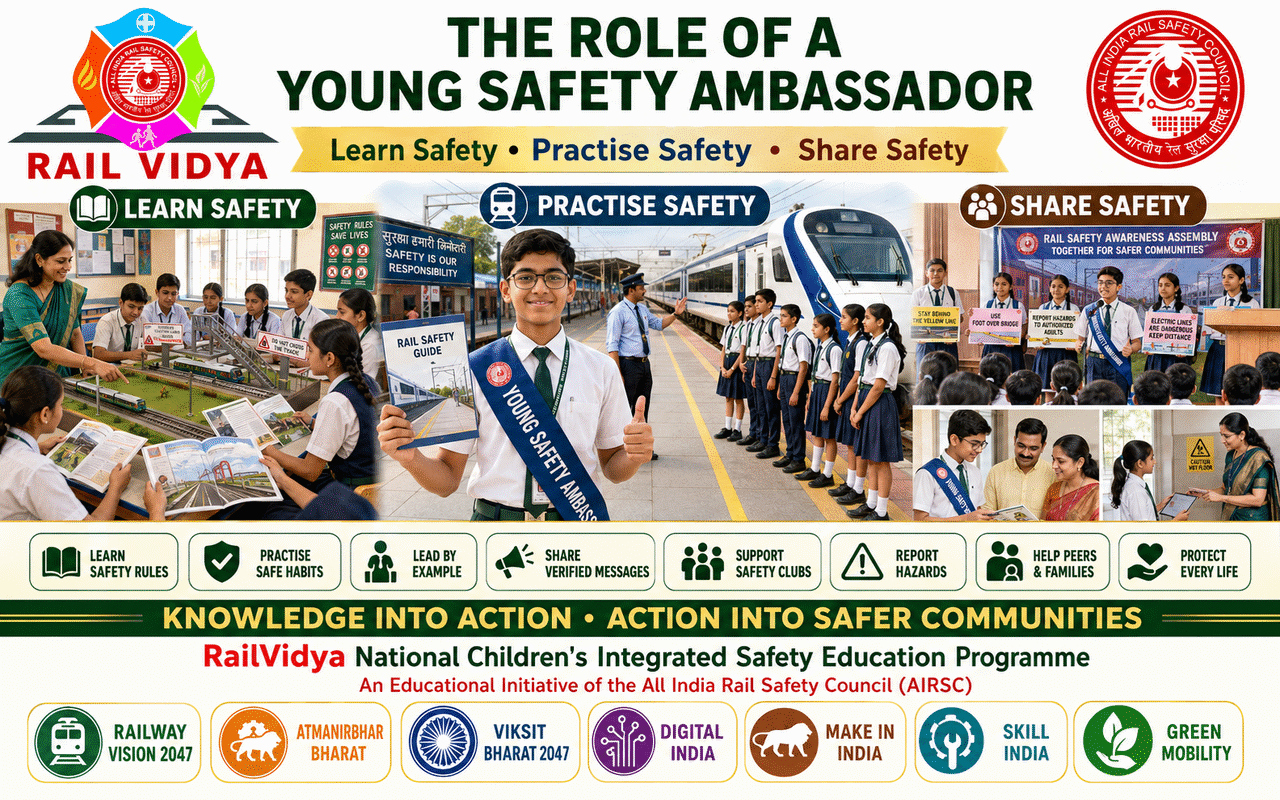
A Young Safety Ambassador is a responsible and safety-conscious student who understands essential safety principles, follows them consistently and inspires others through positive personal conduct. The role is founded on three interconnected commitments: Learn Safety, Practise Safety and Share Safety. Learning develops knowledge and awareness, practice transforms knowledge into safe everyday habits, and sharing carries the benefits of safety education from the student to the family, school and wider community
THE ROLE
OF A YOUNG SAFETY AMBASSADOR
Learn Safety • Practise Safety •
Share Safety
A Young Safety Ambassador is a responsible and safety-conscious student who understands essential safety principles, follows them consistently and inspires others through positive personal conduct. The role is founded on three interconnected commitments: Learn Safety, Practise Safety and Share Safety. Learning develops knowledge and awareness, practice transforms knowledge into safe everyday habits, and sharing carries the benefits of safety education from the student to the family, school and wider community.
A Young Safety Ambassador is not a police officer, emergency responder or enforcement authority. The student’s responsibility is to lead by example, share verified information, recognise and report hazards, participate in authorised safety activities and encourage others through respectful communication. A student must never confront dangerous individuals, enter restricted areas, touch suspicious objects, attempt hazardous repairs or undertake any intervention that could place the student or another person at risk.
Through RailVidya – Children’s Safety Education Programme, the educational wing of the All India Rail Safety Council (AIRSC), Young Safety Ambassadors can become informed student leaders in railway, metro, road, school, home, electrical, environmental, digital, first-aid and disaster safety. Their participation can help transform safety from a collection of instructions into a shared culture founded on prevention, discipline, compassion, alertness and responsible citizenship.
- 1. The Responsibilities of a Young Safety Ambassador
The principal responsibility of a Young Safety Ambassador is to demonstrate safe and responsible behaviour in everyday life. The student should obey traffic signals, use authorised crossings, remain behind railway and metro platform safety lines, avoid mobile-phone distractions near roads and transport areas, protect public property and follow school emergency procedures. When a student practises these behaviours consistently, every safety message communicated to others becomes more credible and meaningful.
A Young Safety Ambassador should remain observant and learn to recognise conditions that may cause injury or harm. These may include damaged electrical wiring, blocked emergency exits, slippery floors, broken furniture, unsafe playground equipment, overcrowding or dangerous behaviour near roads, railway tracks and transport premises. The student must not attempt to repair, move or control the hazard. Instead, the concern should be reported promptly to a teacher, parent, school administrator, safety officer, railway or metro employee, police officer, security official or another authorised adult.
Safety leadership must also promote dignity, equality and inclusion. Young Safety Ambassadors should consider the needs of younger children, senior citizens, persons with disabilities and people who may require additional assistance. No student should be frightened, mocked, humiliated or excluded during a safety activity. A responsible ambassador communicates patiently, reports hazards truthfully, participates sincerely in drills and awareness programmes, protects privacy during emergencies and knows when to step back and seek the assistance of a trained adult.
- 2. One Child • One Family • One Safety Message
The One Child • One Family • One Safety Message initiative recognises that every child can carry an important safety lesson from the classroom into the home. A single well-informed student can positively influence parents, siblings, relatives and neighbours. When children throughout the country share clear, accurate and practical safety messages, awareness can spread naturally across families and communities.
Each participating student may select one verified safety message every week or month and discuss it respectfully with family members. The message should be brief, positive and easy to practise. It may encourage the use of seat belts and helmets, staying away from railway tracks, standing behind platform safety lines, avoiding mobile phones while crossing roads, using electrical equipment responsibly or maintaining an updated emergency-contact list.
The purpose is not to lecture adults or criticise existing family habits. It is to begin a constructive conversation and encourage one practical improvement. A family may agree to use only authorised railway crossings, inspect its first-aid kit, establish an emergency meeting point, verify information before forwarding messages or practise a safe evacuation procedure.
Schools may document participation through family safety pledges, activity cards, student reflections or teacher-supervised feedback. Personal information, photographs and family details should be collected only with proper consent and in accordance with institutional privacy policies. The central message of this initiative is simple and powerful: Educate One Child • Influence One Family • Strengthen One Community.
- 3. Peer-to-Peer Safety Education
Children often respond positively to safety information communicated by trained classmates who understand their daily experiences and speak in familiar language. Peer-to-peer safety education enables Young Safety Ambassadors to reinforce approved messages through supervised conversations, demonstrations, quizzes, role plays, poster exhibitions and classroom activities.
All information used in peer education must be approved by teachers, RailVidya coordinators or qualified safety professionals. Students should explain the correct behaviour clearly without using graphic accident photographs, frightening descriptions, rumours or unverified claims. Effective safety education should create confidence, awareness and responsible behaviour rather than anxiety or panic.
A Young Safety Ambassador must never present themselves as a medical, legal, engineering or emergency-response expert. If a question goes beyond the approved lesson, the student should refer it to a teacher or qualified professional. Saying, “I will verify that information,” is more responsible than guessing or providing inaccurate advice.
A peer-to-peer session may begin by introducing one specific safety topic and explaining why it matters. The student can then present the correct preventive behaviour, discuss a realistic example, invite questions and conclude by repeating the central safety message. Any unresolved concern should be referred to an authorised adult. Students should never be pressured to reveal personal experiences publicly, and concerns involving abuse, bullying, exploitation, self-harm or serious danger must be communicated privately and promptly to responsible adults.
- 4. Planning a School Safety Campaign
A school safety campaign should begin with a clearly defined purpose. It may address railway and metro safety, road safety, school emergency preparedness, electrical safety, cyber safety, first-aid awareness, fire prevention, anti-bullying or another priority identified by the institution. Every campaign should be organised under the supervision of a teacher or designated safety coordinator.
Students and teachers can jointly identify the target audience, campaign period, principal messages, proposed activities, required permissions and methods for evaluating the programme. Messages should be age-appropriate, inclusive, accurate, accessible and relevant to the actual safety environment of the school.
A professionally organised campaign may include a safety pledge during the morning assembly, classroom presentations, approved poster exhibitions, quizzes, debates, supervised role plays, family safety-message cards and awareness sessions conducted by qualified professionals. Railway, metro, police, fire, health or disaster-management personnel may also be invited, subject to institutional approval.
Campaigns must avoid unsafe demonstrations, obstruction of corridors, unauthorised photography, public identification of vulnerable children and visits to hazardous locations without formal permission and professional supervision. Success should be measured through improvements in knowledge, awareness and behaviour—not merely through the number of posters displayed, events conducted or photographs taken.
- 5. Creating Accurate Posters and Digital Safety Messages
Safety posters and digital messages should be clear, accurate, inclusive and action-oriented. A strong safety message explains what action should be taken, why it is important and where assistance can be obtained. It should use a concise title, readable typefaces, suitable colours, short supporting text and a simple visual that demonstrates the correct behaviour.
Every factual statement, emergency number, safety symbol and recommended procedure must be verified through authorised sources before publication. Information may be checked with teachers, RailVidya coordinators, government departments, railway or metro authorities, police, fire services, health agencies or recognised safety organisations.
Graphic accident photographs, identifiable images of injured persons and frightening language should not be used merely to attract attention. Such material may distress children, violate personal dignity and weaken the educational value of the campaign. Positive illustrations showing the correct safety behaviour are usually more appropriate and effective.
Digital communication must respect copyright, consent and privacy. Photographs of students should be used only with institutional and parental permission. Personal contact details, medical information, live locations and identifiable images of accident victims must never be published or forwarded irresponsibly. Before release, every poster and digital message should be reviewed for factual accuracy, language quality, accessibility, visual clarity and institutional approval.
- 6. Conducting a Safety Assembly
A school safety assembly provides an opportunity to communicate an important message to the entire student community in a disciplined, memorable and age-appropriate manner. The programme should be concise, carefully planned, rehearsed and supervised by teachers.
The assembly may begin with a brief introduction to the selected topic, followed by a student speech, quiz, role play, safety pledge or demonstration conducted by an authorised professional. It should explain the principal risk, present the correct preventive action, identify the appropriate reporting channel and conclude with behaviours that students can practise immediately.
For example, a railway-safety assembly may emphasise staying away from tracks, using foot overbridges and authorised crossings, remaining behind platform safety lines and following official instructions. Fire, electrical, medical, rescue or emergency demonstrations must be conducted only by qualified and authorised personnel. No activity should create real danger or imitate an emergency irresponsibly.
Safety assemblies should develop calm awareness and collective responsibility. They must never blame accident victims, shame students, exaggerate risks or use fear as the principal method of education.
- 7. Supporting the RailVidya Safety Club
The RailVidya Safety Club can serve as an organised student platform for continuous safety education, leadership development and community awareness. Young Safety Ambassadors may support the Club by attending meetings, suggesting activities, preparing approved learning materials, assisting with campaigns and encouraging wider student participation.
The Club may maintain an annual calendar covering railway, metro, road, school, home, digital, fire, electrical, environmental and disaster safety. Activities may include monthly safety themes, student talks, quizzes, poster competitions, supervised safety walks, emergency-preparedness awareness, family safety-message initiatives and sessions with authorised professionals. The Club should also promote accessible safety education for students with disabilities and observe significant national and international safety days.
The RailVidya Safety Club must remain an educational and participatory platform. It should never become an enforcement group. Members must not search personal belongings, interrogate classmates, identify alleged rule-breakers publicly or impose punishments. All concerns should be referred discreetly to authorised school personnel.
- 8. Reporting Hazards Through Authorised Channels
Reporting hazards is one of the most valuable responsibilities of a Young Safety Ambassador. Prompt and accurate reporting can help prevent accidents and allow trained personnel to take corrective action. Every student should know the authorised reporting arrangements within the school, transport system and community.
A responsible hazard report should clearly explain what was observed, where and when it was noticed, who may be at risk, whether the danger appears immediate and which responsible adult has been informed. Depending on the location and seriousness of the hazard, it may be reported to a teacher, school administrator, parent, designated safety officer, railway or metro employee, police officer, security official or emergency service.
Students should maintain a safe distance and never touch, move, repair or investigate a hazardous object. Damaged electrical wires, suspicious unattended items, chemical spills, smoke, unstable structures and hazards near railway tracks require immediate professional attention.
All reports must be truthful, accurate and responsible. Exaggerating a situation, spreading rumours, making false allegations or posting unverified claims on social media can cause panic and damage public trust. When a report involves another person, privacy, fairness and dignity should be maintained while authorised adults assess the concern.
- 9. Community Service Without Unsafe Intervention
Community service can help children develop compassion, civic awareness and social responsibility. Young Safety Ambassadors may participate in supervised awareness walks, poster campaigns, cleanliness initiatives, family education, environmental programmes and community-preparedness activities. However, no activity should require a child to enter a dangerous area or perform the duties of trained emergency responders.
Students must never attempt to control traffic, enter railway tracks, approach fires or electrical hazards, handle medical waste, confront violent individuals, rescue people from deep water or investigate suspicious objects. These situations require trained and authorised professionals.
The correct principle is: Observe Safely • Report Promptly • Support Responsibly. Students can contribute by sharing verified information, preparing educational materials, assisting participants during supervised events, supporting accessibility, reporting hazards, thanking safety personnel and participating in approved community programmes. Protecting one’s own life is an essential part of helping others. Refusing to enter a dangerous situation is not a failure to help; it is a responsible and safety-conscious decision.
- 10. Children’s Contribution to Vision Zero
Vision Zero represents the principle that no preventable death or serious injury should be accepted as an unavoidable consequence of mobility or development. Children can contribute to this vision by understanding that railway, metro, road and public-transport accidents are not merely statistics. Every life is valuable, and many injuries can be prevented through safer systems, informed behaviour and collective responsibility.
Students support Vision Zero when they follow transport rules, use helmets and seat belts, choose authorised crossings, stay away from railway tracks and restricted areas, avoid mobile-phone distraction and encourage family members to adopt safe travel habits. They also contribute by reporting unsafe infrastructure responsibly, supporting inclusive mobility, sharing verified prevention messages, respecting transport workers and participating in school and community safety programmes.
Children must not be made solely responsible for accident prevention. Governments, transport authorities, educational institutions, engineers, vehicle operators, enforcement agencies and adult road users carry major responsibilities for creating safe systems. The child’s role is to practise safe behaviour, communicate awareness and participate meaningfully in the shared mission of protecting every life.
- 11. Building a Safety-Conscious India
Building a safety-conscious India requires more than occasional campaigns. Safety must become an everyday national value reflected in education, transportation, infrastructure, technology, institutional practices and personal conduct. Children are central to this transformation because responsible habits developed during childhood can continue throughout life.
A safety-conscious India is one in which people follow rules even when no one is watching, report hazards before accidents occur and protect vulnerable members of society. It is a nation in which schools teach prevention, families demonstrate responsible behaviour, authorities provide safe systems and communities cooperate calmly during emergencies.
Young Safety Ambassadors can help build this future by carrying knowledge from the classroom into the home and from the home into the community. When a child reminds a family member to wear a helmet, refuses to cross a closed railway gate, reports a damaged electrical wire, supports a classmate during an emergency drill or shares a verified cyber-safety message, that child is contributing meaningfully to national safety.
The long-term vision is to develop a generation that recognises safety as an essential element of responsible citizenship. Such a generation will choose prevention over carelessness, cooperation over indifference and protection of life over convenience. Through education, participation and positive leadership, children can help create safer homes, safer schools, safer journeys, safer communities and a stronger India.
Young Safety Ambassador’s Commitment
As a Young Safety Ambassador, I will learn safety with attention, practise safety with discipline and share safety messages responsibly. I will respect established rules, protect public property and report hazards through authorised channels. I will never knowingly place myself or another person in danger. I will support younger children, senior citizens, persons with disabilities and everyone who may require additional assistance. I will use digital platforms safely, protect the privacy and dignity of others and refuse to spread rumours or unverified information. Through positive personal conduct, responsible communication and compassionate leadership, I will contribute to a safer school, a safer community and a safety-conscious India.
Learn Safety • Practise Safety • Share Safety • Protect Every Life
One Child • One Family • One Safety Message • One Safer Nation
RailVidya – Empowering Young Safety Ambassadors to Lead India Towards Vision Zero
© 2026 Dr.R.Padmanabhan. All Rights Reserved.
Chairman — All India Rail Safety Council (AIRSC)
Promoting Railway Safety, Education and Public Awareness
Email: admin@railsafety.co.in | Website: www.railsafety.co.in/ www.railsafety.in/ www.airsc.in