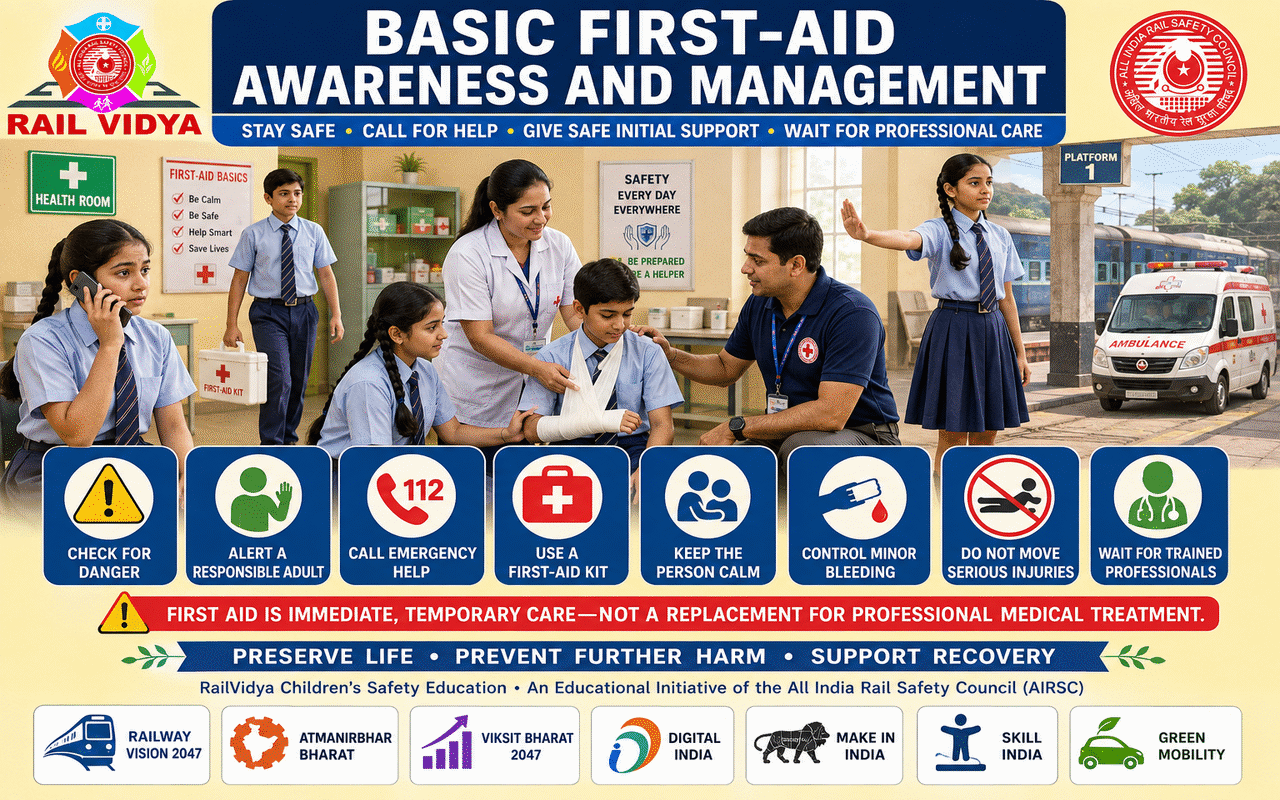
Basic First-Aid Awareness and Management equips students with the knowledge to recognise injuries and medical emergencies, remain calm, check for danger, call responsible adults or emergency services and provide safe initial support within their level of training. Through RailVidya, children learn that personal safety, clear communication, compassion and timely professional medical assistance are the highest priorities—and that they must never attempt dangerous rescues or untrained medical procedures.
Basic First-Aid Awareness and Management
Basic first-aid awareness is an essential life skill that enables students to recognise an injury or medical emergency, protect themselves from danger, obtain responsible adult assistance and provide safe initial support until trained medical personnel arrive. First aid is not a replacement for professional medical treatment. It is the immediate and temporary care given to a person who has been injured or suddenly becomes unwell, with the purpose of preserving life, preventing the condition from worsening and supporting recovery.
Children may encounter minor injuries or unexpected emergencies at home, in school, on the playground, during travel or in public places. Cuts, bleeding, burns, falls, sprains, fainting, choking, breathing difficulties, allergic reactions and heat-related illness can occur without warning. Age-appropriate first-aid education helps students remain calm, identify warning signs and take responsible action without panic, delay or unsafe experimentation.
The first responsibility of a student during any emergency is to ensure personal safety. Before approaching an injured or unwell person, the student must check whether the location contains dangers such as moving traffic, fire, smoke, electricity, broken glass, chemicals, deep water, railway tracks or unstable structures. A child must never enter a dangerous area or risk becoming another casualty. The safest action is to keep away from the hazard, warn others and immediately alert a teacher, parent, responsible adult, security professional or emergency service.
Students should be guided by a simple response sequence: Stay Calm, Check for Danger, Call for Help and Provide Safe Support. They should quickly observe whether the person is responsive and breathing normally, without shaking the casualty or causing unnecessary movement. If the individual is unconscious, experiencing severe breathing difficulty, bleeding heavily, having a seizure, suffering a serious burn or showing signs of a major injury, emergency medical assistance must be requested immediately. In India, 112 may be used for integrated emergency assistance.
Clear communication can save valuable time. When contacting an adult or emergency service, the student should provide the exact location, describe what happened, state the number of people affected and explain any visible danger. The caller should listen carefully, follow the instructions given and avoid ending the call until advised. If several students are present, one should seek help while the others maintain a safe area and prevent crowding.
For a minor cut or wound, assistance should be provided only within the student’s level of training and under adult supervision whenever possible. Hands should be cleaned, and direct contact with another person’s blood should be avoided. A clean dressing or cloth may be applied with gentle, steady pressure to help control bleeding. Substances such as soil, ash, powder or unprescribed medicine must never be placed on an open wound. Persistent or heavy bleeding requires urgent professional medical attention.
Burn injuries require prompt and careful action. The affected area should be cooled under clean, gently running water, and tight items near the injury may be removed only if they are not attached to the skin. Ice, butter, toothpaste, oil, ink or other household substances must never be applied. Blisters should not be broken, and material stuck to the burn should not be pulled away. Serious burns, electrical burns, chemical burns and burns involving the face, hands or a large body area require immediate adult and medical assistance.
When a person falls or may have suffered a head, neck, back or bone injury, students should not attempt to lift, pull, straighten or move the individual unless remaining in place creates an immediate danger. The casualty should be encouraged to remain still while help is summoned. A child must never attempt to force a limb back into position. Pain, swelling, deformity, confusion, vomiting, loss of consciousness or difficulty moving may indicate a serious injury requiring medical assessment.
If someone faints, the priority is to protect the person from further injury, create space for ventilation and obtain adult help. The student should not crowd around the casualty, force the person to stand or give food or drink while the individual is not fully alert. Continued unconsciousness, breathing difficulty, seizure activity or repeated fainting requires urgent medical attention.
Choking and breathing emergencies can become life-threatening within a short period. Students should recognise warning signs such as an inability to speak, cough or breathe normally. They must call for adult and emergency assistance immediately. Physical choking interventions and cardiopulmonary resuscitation should be performed only by individuals who have received appropriate practical training and are able to follow recognised procedures or live instructions from emergency professionals.
During a seizure, students should make the surrounding area safer by moving nearby hazards away, protecting the person from accidental injury and calling a responsible adult. They must not restrain the person, place anything in the mouth or attempt to give food, water or medicine. The duration of the seizure should be observed, and urgent medical help should be obtained when directed by school protocol or when serious warning signs are present.
Food, drink or medication should not be given casually to an injured or unwell person. Students must never share prescription medicine or administer an unknown medicine. A person who is unconscious, confused, vomiting or having difficulty swallowing must not be given anything by mouth. Known medical conditions—such as asthma, diabetes, epilepsy or severe allergy—must be managed according to the individual’s authorised medical plan and with assistance from trained adults.
In railway, metro and road environments, first aid must always begin with scene safety. Students must never enter railway tracks, roadways, electrical areas or restricted locations to reach an injured person. They should notify railway personnel, metro staff, police, teachers, guardians or emergency services and provide accurate information. Crowd control, safe distance and cooperation with authorised responders are essential because an unsafe rescue attempt may create additional casualties.
Every school should maintain clearly marked and regularly checked first-aid kits in accessible locations. Students should know where these kits are kept and which trained adults are authorised to use them. A basic kit may contain sterile dressings, adhesive bandages, gauze, disposable gloves, medical tape and other approved supplies. Medicines should be stored and administered only according to school policy and appropriate medical authorisation.
First-aid learning should include supervised demonstrations, practical exercises, emergency-call simulations and age-appropriate training delivered by qualified instructors. Reading about first aid is valuable, but practical skills—particularly CPR and choking response—must be learned through recognised hands-on training and refreshed periodically. Students should also understand their personal limits and never perform a procedure they have not been trained to undertake.
Compassion is an important part of first-aid management. An injured or frightened person should be treated calmly, respectfully and without judgement. Students can offer reassurance, protect the person’s privacy, prevent unnecessary photography or video recording and keep bystanders at a safe distance. They should never spread rumours, share images of the casualty or turn an emergency into entertainment.
Basic first-aid awareness transforms students from passive observers into responsible and informed helpers. The most valuable contribution may be recognising danger, calling for help promptly, giving accurate information, reassuring the casualty and cooperating with trained responders. Through correct education and supervised practice, every student can develop the confidence to act responsibly while understanding that personal safety and professional medical assistance must always remain the highest priorities.
Stay Calm • Check for Danger • Call for Help • Provide Safe Support
RailVidya – Empowering Young Minds with the Knowledge to Respond Responsibly and Protect Life
© 2026 Dr.R.Padmanabhan. All Rights Reserved.
Chairman — All India Rail Safety Council (AIRSC)
Promoting Railway Safety, Education and Public Awareness
Email: admin@railsafety.co.in | Website: www.railsafety.co.in/ www.railsafety.in/ www.airsc.in
Basic First-Aid Awareness and Management equips students with the knowledge to recognise injuries and medical emergencies, remain calm, check for danger, call responsible adults or emergency services and provide safe initial support within their level of training. Through RailVidya, children learn that personal safety, clear communication, compassion and timely professional medical assistance are the highest priorities—and that they must never attempt dangerous rescues or untrained medical procedures.