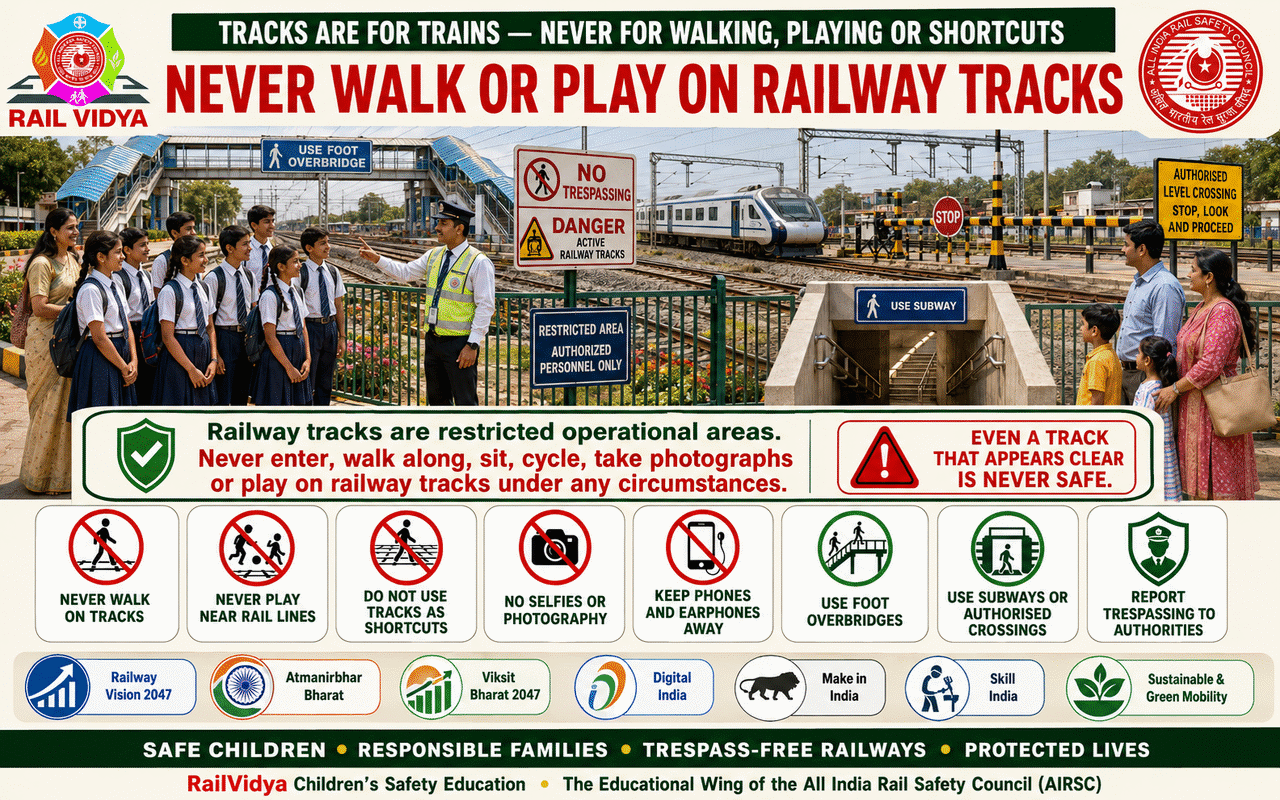
“Never Walk or Play on Railway Tracks” delivers a clear life-saving message that railway tracks are restricted operational areas meant only for trains and authorised activities. Through RailVidya, children and communities are taught never to walk, play, cycle, take photographs or use tracks as shortcuts, even when no train is visible. Everyone must use authorised crossings, remain alert, respect railway barriers and report unsafe behaviour to responsible adults or railway officials without attempting a dangerous rescue.
Never Walk or Play on Railway Tracks
Railway tracks are highly restricted operational areas designed exclusively for the movement of trains and authorised railway activities. They are never safe places for walking, playing, sitting, cycling, taking photographs or using as shortcuts. Through RailVidya Children’s Safety Education, the educational wing of the All India Rail Safety Council (AIRSC), children, families and communities are encouraged to understand one essential life-saving message: never enter, walk along or play on railway tracks under any circumstances.
A railway track may appear quiet, especially when no train is immediately visible. However, this appearance can create a dangerous and misleading sense of safety. Trains may approach unexpectedly from either direction, change tracks through points and crossings, or move through the area without stopping. Maintenance vehicles and other authorised railway equipment may also operate with limited warning. Every railway line must therefore be treated as active at all times.
Trains are extremely heavy, travel at considerable speed and require a long distance to stop after the brakes are applied. A train driver who sees a person on the track may sound the horn and activate emergency braking, but may still be unable to stop in time. Children must understand that a train cannot turn away to avoid a person and that the responsibility for remaining safe begins with staying completely outside the railway track area.
The speed and distance of an approaching train can be difficult to judge accurately. A train that appears far away may reach a location within seconds, particularly on high-speed or multiple-track routes. Sound can also be misleading because of wind, nearby buildings, curves, tunnels, bridges, background noise or the quiet operation of some modern trains. Depending only on sight or hearing to decide whether a track is safe to enter is extremely dangerous.
Railway tracks contain many physical hazards even when no train is present. Rails, sleepers, stones, points, cables and uneven ground can cause a person to slip, trip or become trapped. Bridges, tunnels, railway yards and narrow track sections may provide little or no safe space to escape from an approaching train. Entering these environments can place both children and anyone attempting to rescue them in immediate danger.
Playing near railway tracks can quickly become life-threatening. Balls, kites, toys or personal belongings may fall onto the line, but no child should ever attempt to retrieve them. The correct action is to remain in a safe place and inform a parent, teacher, railway employee or another authorised adult. No object, however valuable, is more important than a child’s life.
Mobile phones, headphones, photography and social-media activities create further danger by reducing awareness. A distracted person may fail to notice a train, warning horn, signal or instruction from railway personnel. Children must never use tracks as locations for photographs, videos, games or online challenges. Risky content is not courageous or entertaining; it can lead to irreversible tragedy and may encourage others to imitate unsafe behaviour.
Railway tracks must never be used as convenient shortcuts to schools, homes, markets or workplaces. Saving a few minutes is never worth risking a life. Children and adults should cross railway lines only through authorised facilities such as foot overbridges, subways and officially designated level crossings. Fences, barriers, warning signs and closed gates must always be respected and must never be climbed over, passed around or ignored.
Children living or studying near railway infrastructure require continued safety education and responsible adult guidance. Repeated exposure to tracks can make the environment appear familiar, but familiarity does not reduce the danger. Parents, teachers, community leaders and local organisations should identify safe routes, discourage trespassing and consistently demonstrate the behaviour they expect children to follow.
Adults carry a particularly important responsibility because children often learn by observation. When adults cross tracks illegally or use unauthorised shortcuts, children may assume that such behaviour is acceptable. Every parent, teacher and community member must set a positive example by using designated crossings and obeying railway warnings. The safety lesson communicated through responsible action is often more powerful than the lesson communicated through words.
If a child sees another person entering or playing on railway tracks, the child should not follow or attempt a rescue that creates additional danger. The safest response is to remain away from the tracks, alert a responsible adult or authorised railway official and clearly report the location. During any emergency, children should remain calm and follow the directions of trained personnel.
Preventing railway-track trespassing requires cooperation among schools, families, railway authorities, safety organisations and communities. Awareness sessions, school assemblies, posters, safety clubs, community campaigns and safe-route education can reinforce this vital message. Special attention should be given to railway-adjacent communities, where regular engagement can help replace unsafe habits with responsible alternatives.
As India develops faster trains, modern stations and an increasingly advanced railway network under the national aspirations of Viksit Bharat 2047, public awareness must advance alongside technology. Modernisation increases the importance of respecting railway boundaries and authorised access. A future-ready railway system must be supported by citizens who value life, follow safety procedures and teach the next generation to do the same.
Through RailVidya, the All India Rail Safety Council seeks to establish a strong national culture in which entering railway tracks is universally recognised as dangerous and unacceptable. Every child protected from track-related risk represents a family safeguarded, a tragedy prevented and a stronger safety-conscious nation.
The message is simple, permanent and life-saving: railway tracks are for trains—not for walking, playing, photography or shortcuts. Always stay away and always use an authorised crossing.
Stay Off the Tracks • Use the Safe Route • Protect Your Life • Reach Home Safely
© 2026 Dr.R.Padmanabhan. All Rights Reserved.
Founder Chairman — All India Rail Safety Council (AIRSC)
Promoting Railway Safety, Education and Public Awareness
Email: admin@railsafety.co.in | Website: www.railsafety.co.in / www.railsafety.in