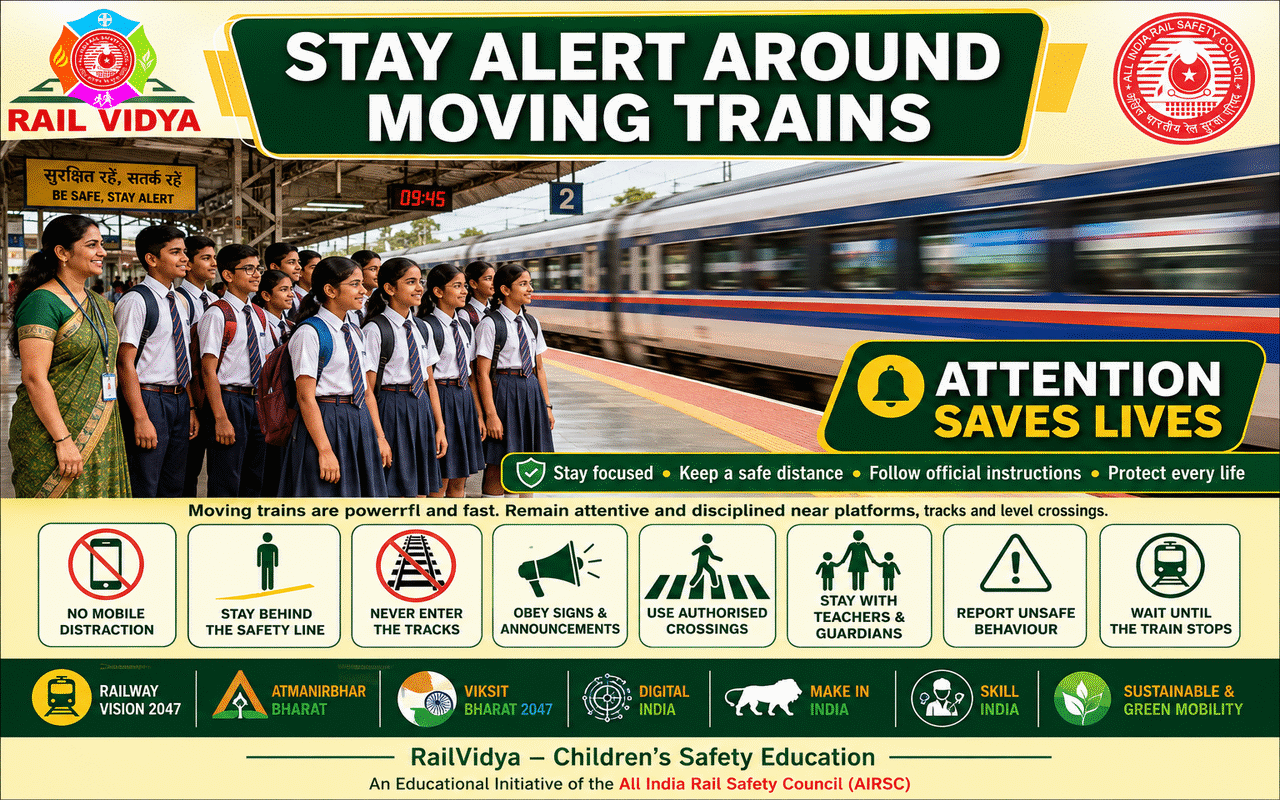
“Stay Alert Around Moving Trains” teaches children to remain attentive, maintain a safe distance and follow every railway warning near platforms, tracks and level crossings. Through RailVidya, students learn never to chase, touch, board or leave a moving train; to stay behind platform safety lines; and to avoid mobile phones, headphones and unsafe photography. Alert behaviour, responsible adult supervision and prompt reporting to authorised personnel can prevent accidents and protect every life.
Stay Alert Around Moving Trains
Remaining alert around moving trains is one of the most important principles of railway safety. Trains are large, powerful and fast-moving vehicles that operate within a highly controlled environment. A moment of distraction near a railway track, platform or level crossing can create a serious and irreversible risk. Through RailVidya Children’s Safety Education, the educational wing of the All India Rail Safety Council (AIRSC), children are taught to remain attentive, disciplined and aware whenever they are near trains or railway infrastructure.
Children must understand that trains cannot stop or change direction immediately. Because of their enormous weight, speed and long braking distance, even an alert train driver may be unable to prevent an accident after noticing a person or obstruction ahead. The safest protection is therefore to remain outside operational areas, maintain a secure distance and follow all official railway signs, announcements, barriers and instructions.
A moving train may appear to be travelling slowly when viewed from a distance, but its actual speed can be significantly higher. The size of a train can make it difficult to judge how quickly it is approaching, while curves, station buildings, other trains and poor weather may limit visibility. Children should never estimate whether there is enough time to cross a track, walk near a moving train or retrieve an object from the railway line.
Railway platforms require continuous attention. Children should remain behind the designated safety line and stand away from the platform edge, particularly when a train is approaching, passing through or leaving the station. The movement of a train can create strong air pressure, turbulence and sudden noise that may cause a person to lose balance. Running, pushing, playing or standing too close to the edge must always be avoided.
Children should never chase, touch or run alongside a moving train. They must not attempt to board after a train has started moving or jump from a train before it has stopped completely. Such actions can cause a person to slip into the gap between the train and platform or fall beneath the wheels. Boarding and alighting should take place calmly, one person at a time and only when the train is stationary and safe access is available.
Doors, steps and gaps between trains and platforms are areas requiring particular care. Children should remain close to a responsible adult, use handholds where appropriate and watch their step while boarding or alighting. They should never stand, sit or play near coach doors, lean outside a moving train or place their hands, head, clothing or personal belongings beyond the coach.
Distraction is a major risk around moving trains. Mobile phones, headphones, games, photography and conversations can prevent children from noticing warning horns, announcements, signals or changes in their surroundings. Electronic devices should be put away when walking through stations, using crossings, boarding or alighting. Full attention should remain on the environment and the directions of parents, teachers and railway personnel.
Headphones and earphones are especially hazardous because they can block important warning sounds. Children must never wear them near railway tracks, on platform edges or at level crossings. Even when a train is visible, another train may be approaching on an adjacent track. The ability to hear and understand warnings is an essential part of remaining safe.
At level crossings, children must wait patiently behind the barrier or designated safety point whenever warning lights, bells or gates are active. They should never pass around or beneath a closed barrier, even if a train appears to have already passed. A second train may approach from the opposite direction or on another line. Crossing is permitted only after the warning has ended and the gate has been officially opened.
Children must never play, take photographs, make videos or participate in online challenges near moving trains. Railway environments are not locations for entertainment or risky content creation. A photograph or video is never worth endangering a life. Responsible digital behaviour is therefore an important component of modern railway-safety education.
Loose clothing, scarves, bags, toys and other belongings should be kept securely away from moving trains. Children should avoid carrying objects that obstruct their view or affect their balance. Nothing should ever be thrown towards a train, placed on a railway track or extended outside a coach, as such actions can injure passengers, railway personnel or people standing nearby.
If a personal belonging falls onto a railway track, no child or adult should attempt to retrieve it directly. The safe response is to remain away from the track and immediately notify authorised railway personnel. Objects can be recovered through proper procedures; human life cannot be replaced.
Children should also know how to respond if they observe unsafe behaviour or a possible emergency. They should remain in a safe place, inform a responsible adult or authorised railway official and clearly explain what they have seen. They must never enter an operational area or attempt a rescue that places their own life at risk. Alertness includes recognising danger and seeking the right assistance.
Parents, teachers and guardians carry a special responsibility to model attentive behaviour. Adults who use mobile phones while walking near platforms, rush towards moving trains or ignore warning systems may unintentionally encourage children to copy unsafe conduct. Responsible supervision and consistent personal example are essential to building reliable safety habits.
Schools can strengthen this message through classroom education, demonstrations, stories, posters, quizzes, station-safety orientation and role-play activities. Regular learning helps children recognise risk, resist peer pressure and develop the confidence to choose safety even when others behave carelessly. RailVidya seeks to support this educational process through practical and child-friendly resources.
As India progresses towards faster, smarter and more technologically advanced railways under the vision of Viksit Bharat 2047, public awareness must develop alongside railway modernisation. Modern trains may operate with greater speed and reduced noise, making disciplined passenger behaviour and continuous attention increasingly important. A future-ready railway system requires a future generation that is alert, informed and responsible.
Through RailVidya, the All India Rail Safety Council seeks to establish alertness as a lifelong public-safety value. A vigilant child becomes a responsible passenger, a positive influence within the family and a safety-conscious citizen. Every attentive decision near a moving train contributes to accident prevention and the protection of precious lives.
The national message is clear: stop distractions, maintain a safe distance, follow official instructions and remain fully alert whenever a train is approaching, moving or departing.
Stay Alert • Stand at a Safe Distance • Avoid Distractions • Protect Every Life
© 2026 Dr.R.Padmanabhan. All Rights Reserved.
Chairman — All India Rail Safety Council (AIRSC)
Promoting Railway Safety, Education and Public Awareness
Email: admin@railsafety.co.in | Website: www.railsafety.co.in / www.railsafety.in