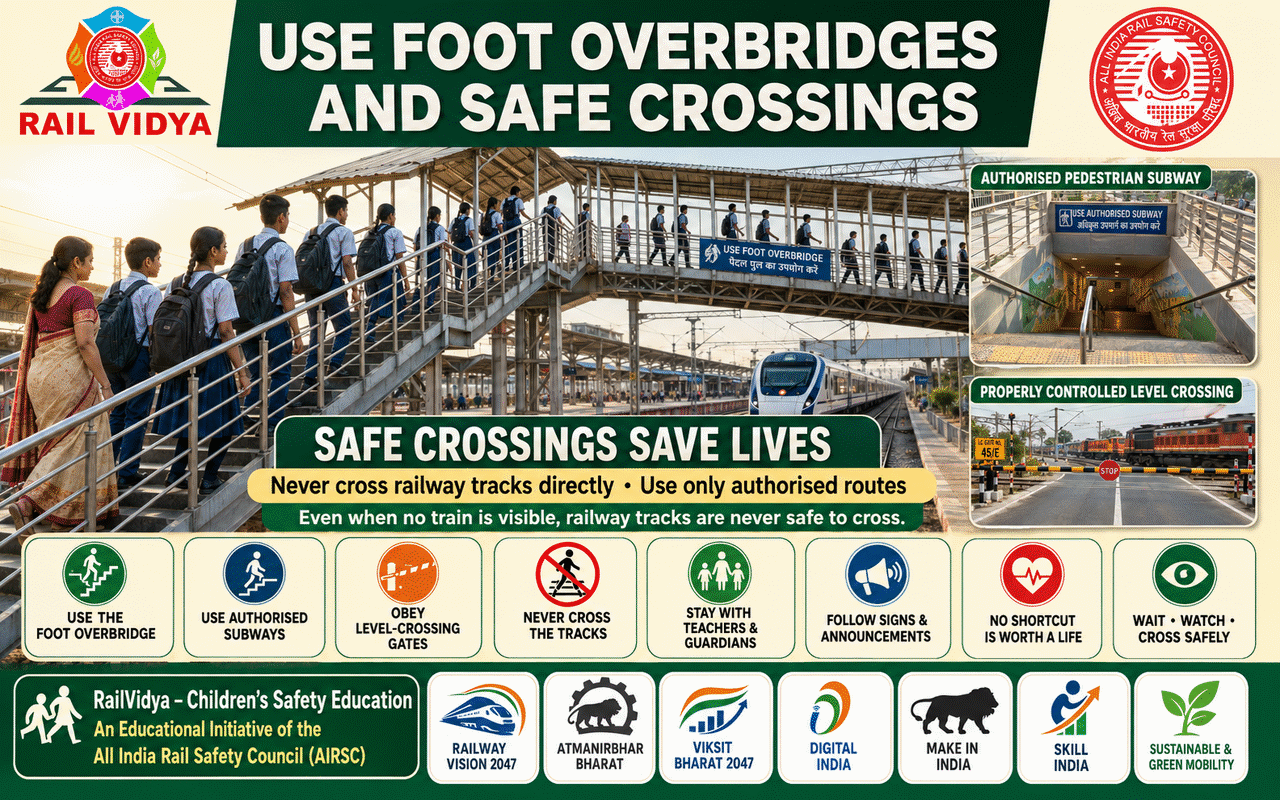
“Use Foot Overbridges and Safe Crossings” teaches children and families never to cross railway tracks directly, even when no train is visible. Through RailVidya, passengers are encouraged to use designated foot overbridges, subways, underpasses or authorised level crossings, obey all barriers and warnings, remain attentive and avoid unsafe shortcuts. Choosing the approved route and following responsible adult guidance are simple, life-saving habits that protect every journey.
Use Foot Overbridges and Safe Crossings
Using foot overbridges and authorised safe crossings is one of the most important railway-safety practices for children, families and the travelling public. RailVidya Children’s Safety Education, the educational wing of the All India Rail Safety Council (AIRSC), promotes a clear national message: railway tracks must never be crossed directly, even when no train appears to be approaching. Every person should use a designated foot overbridge, subway or officially authorised level crossing to reach the other side safely.
Foot overbridges are specially designed to allow passengers and pedestrians to move safely from one platform or side of a railway line to another without entering the operational track area. They separate people from moving trains, railway equipment and electrical hazards. Although using a foot overbridge may require additional time or effort, it provides a controlled and protected route. Saving a few minutes by taking an unauthorised shortcut can never justify placing a life in danger.
A railway track that appears clear is not necessarily safe to cross. Trains may approach at high speed from either direction, move on an adjacent line or change tracks unexpectedly. Curves, buildings, stationary trains, weather conditions and background noise can prevent pedestrians from seeing or hearing an approaching train. Modern trains may also be quieter than expected. No child or adult should rely solely on personal judgement to decide whether it is safe to enter a railway line.
Trains cannot stop suddenly. Their enormous weight, operating speed and long braking distance mean that even an alert train driver may be unable to prevent an accident after seeing someone on the track. A person crossing directly may also stumble over rails, slip on loose stones or become trapped between track components. Authorised crossings are provided precisely because individual judgement cannot safely manage these risks.
Children should use foot overbridges, subways and station crossing facilities only with calm and orderly behaviour. They should walk without running, pushing or playing; use handrails where available; remain close to a responsible adult; and avoid looking at mobile phones while moving. School bags, clothing and personal belongings should be carried securely to reduce the risk of tripping or blocking other pedestrians.
Foot overbridges can become crowded during peak travel periods. Children should remain patient, move with the flow of pedestrians and avoid sitting or gathering on stairways and landings. They should never slide on handrails, lean over barriers, climb protective fencing or throw objects towards tracks, trains or overhead electrical equipment. If a route becomes heavily congested, they should stay with their parent, teacher or group leader and follow the directions of authorised staff.
Subways and pedestrian underpasses are also safe alternatives for crossing railway lines. Children should use the designated walkway, avoid isolated or restricted sections and remain with responsible adults. Water accumulation, damaged lighting, obstruction or another unsafe condition should be reported to railway personnel. Such conditions do not justify entering or crossing the tracks; an alternative authorised route should always be used.
At level crossings, pedestrians and road users must obey gates, barriers, warning lights, bells, signs and instructions from authorised personnel. Children must never pass beneath or around a closed barrier, even if other people are doing so. They should wait at a safe distance until the warning has stopped, the gate has been officially opened and passage is clearly permitted. Crossing immediately behind one train is also dangerous because another train may be approaching on a neighbouring line.
At unmanned or limited-control crossings, where legally accessible, children should cross only under appropriate adult supervision and in accordance with displayed instructions. They must stop, remain alert and use the authorised pathway without delay or distraction. However, the safest available grade-separated facility—such as a foot overbridge, subway, road overbridge or underpass—should always be preferred.
Accessibility is an important part of safe mobility. Children, senior citizens, passengers carrying infants and persons with disabilities may require lifts, ramps, escalators or staff assistance where these facilities are available. Children should never operate mobility equipment carelessly or play near escalators and lifts. Offering patient and respectful assistance under adult guidance helps create an inclusive and responsible railway environment.
Parents and teachers have a powerful role in establishing safe crossing habits. Children learn by observing adults, and an adult who enters the tracks or ignores a closed barrier can unintentionally normalise dangerous behaviour. Families and educational institutions must consistently demonstrate that designated routes are compulsory, not optional. Every journey should be planned with sufficient time so that haste does not encourage unsafe shortcuts.
Schools located near railway lines can strengthen protection by identifying approved routes and teaching them to students and families. Safety maps, supervised walks, classroom demonstrations, posters and community-awareness programmes can help children distinguish between authorised and prohibited crossing points. School authorities and community leaders should coordinate with relevant local agencies when safe pedestrian access requires attention or improvement.
If a child becomes separated from a parent or group, reaches the wrong platform or misses a train, the child must never cross the tracks to resolve the situation. The correct action is to remain calm and seek assistance from uniformed railway staff, Railway Protection Force personnel, police officers or an authorised help desk. A missed train or delayed journey can be managed; entering an operational railway track can have irreversible consequences.
Through RailVidya, AIRSC seeks to make the use of foot overbridges and authorised crossings a permanent public-safety habit across India. This mission supports accident prevention, responsible passenger behaviour and respect for railway infrastructure. It also reinforces the principle that safety depends on everyday decisions made by individuals, families and communities.
As India advances towards Viksit Bharat 2047, railway modernisation must include not only advanced trains and infrastructure but also safe, accessible and disciplined passenger movement. A developed railway system requires citizens who respect designated pathways and never compromise safety for convenience. Educating children in these habits today will help build the responsible railway culture of tomorrow.
The national message is simple and life-protecting: never cross railway tracks directly. Use a foot overbridge, subway or authorised crossing every time—because the safe route is always the right route.
Choose the Safe Crossing • Never Take a Shortcut • Follow Railway Instructions • Protect Every Journey
© 2026 Dr.R.Padmanabhan. All Rights Reserved.
Founder Chairman — All India Rail Safety Council (AIRSC)
Promoting Railway Safety, Education and Public Awareness
Email: admin@railsafety.co.in | Website: www.railsafety.co.in / www.railsafety.in