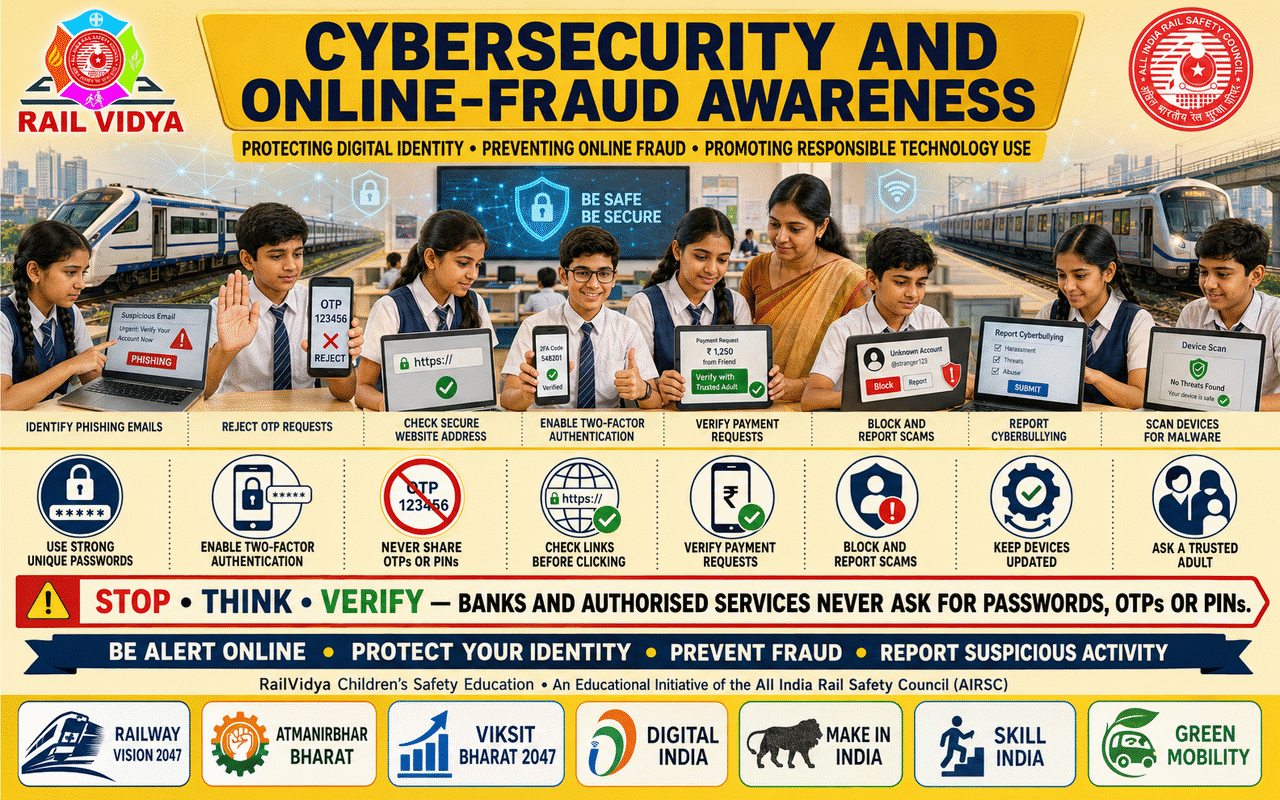
Think Before You Click • Verify Before You Trust • Protect Before You Share • Report Before Harm Spreads Cyber-Safe Child • Secure Family • Responsible Digital Citizen • Safer India
Cybersecurity and Online-Fraud Awareness
Protecting Digital Identity • Preventing Online Fraud • Promoting
Responsible Technology Use
Cybersecurity and online-fraud awareness are essential life skills for every student in today’s digitally connected world. Children and young people regularly use smartphones, computers, educational platforms, social media, online games, digital-payment services and communication applications. Although these technologies create valuable opportunities for learning and communication, they can also expose students to identity theft, phishing, fake websites, financial scams, cyberbullying, malicious software, account hacking and misuse of personal information. Effective digital-safety education enables students to enjoy the benefits of technology while recognising risks and responding responsibly.
The RailVidya National Children’s Integrated Safety Education Programme, an educational initiative of the All India Rail Safety Council (AIRSC), promotes cybersecurity as an important component of comprehensive child-safety education. The programme helps students understand that passwords, photographs, identification documents, banking information, one-time passwords, QR codes, live locations and other personal details must never be shared carelessly. It encourages them to verify unfamiliar messages, links, websites and online requests before clicking, downloading, responding or making any payment.
Students must be taught to recognise common warning signs of online fraud, including unexpected prize announcements, fake scholarship or employment offers, impersonation of trusted organisations, urgent requests for money, suspicious customer-care numbers, fraudulent railway or travel-booking links and messages asking for confidential information. They should understand that genuine institutions do not normally request passwords, PINs or one-time passwords through unsolicited calls, emails or messages. A message that creates fear, excitement or pressure should always be treated with caution and verified through an official source.
Cybersecurity also depends upon disciplined digital habits. Students should use strong and unique passwords, activate multi-factor authentication wherever available, keep devices and applications updated, install software only from trusted sources and avoid accessing sensitive accounts through unsecured public networks. Privacy settings should be reviewed regularly, and unknown friend requests, suspicious attachments and unverified applications should be avoided. Shared or public devices must never be used without properly signing out and protecting personal information.
Online conduct is equally important. Students must communicate respectfully, protect the privacy of others and avoid creating or forwarding harmful, misleading or humiliating content. Cyberbullying, impersonation, online harassment, circulation of private images and deliberate spreading of false information can cause serious emotional, social and legal consequences. Children should be encouraged to preserve evidence, block suspicious accounts and immediately report unsafe online experiences to a parent, teacher, guardian or another trusted adult.
Special attention must be given to digital-payment safety. Students should never scan an unknown QR code, approve an unfamiliar payment request, share banking credentials or install a screen-sharing application at the direction of an unknown caller. Before making an online payment or booking a railway, metro or travel service, they should confirm that the website or application is genuine and officially authorised. If fraud is suspected, the relevant bank or service provider should be contacted promptly through verified channels, and the incident should be reported to the appropriate cybercrime authority.
Schools, teachers and parents have a shared responsibility to create an environment in which children can discuss online mistakes or suspicious experiences without fear or embarrassment. Early reporting can prevent further harm, protect financial and personal information and help authorities respond effectively. Regular awareness sessions, practical demonstrations, age-appropriate case studies and simulated fraud-recognition activities can strengthen students’ ability to make safe decisions in real-world situations.
Through structured cybersecurity and online-fraud education, RailVidya aims to develop informed, alert and responsible digital citizens. A student who pauses before clicking, verifies before trusting, protects personal information and reports suspicious activity becomes an important defender of the family, the school and the wider community.
Think Before You Click • Verify Before You Trust • Protect Before You Share • Report Before Harm Spreads
Cyber-Safe Child • Secure Family • Responsible Digital Citizen • Safer India
© 2026 Dr.R.Padmanabhan. All Rights Reserved.
Chairman — All India Rail Safety Council (AIRSC)
Promoting Railway Safety, Education and Public Awareness
Email: admin@railsafety.co.in | Website: www.railsafety.co.in/ www.railsafety.in/ www.airsc.in