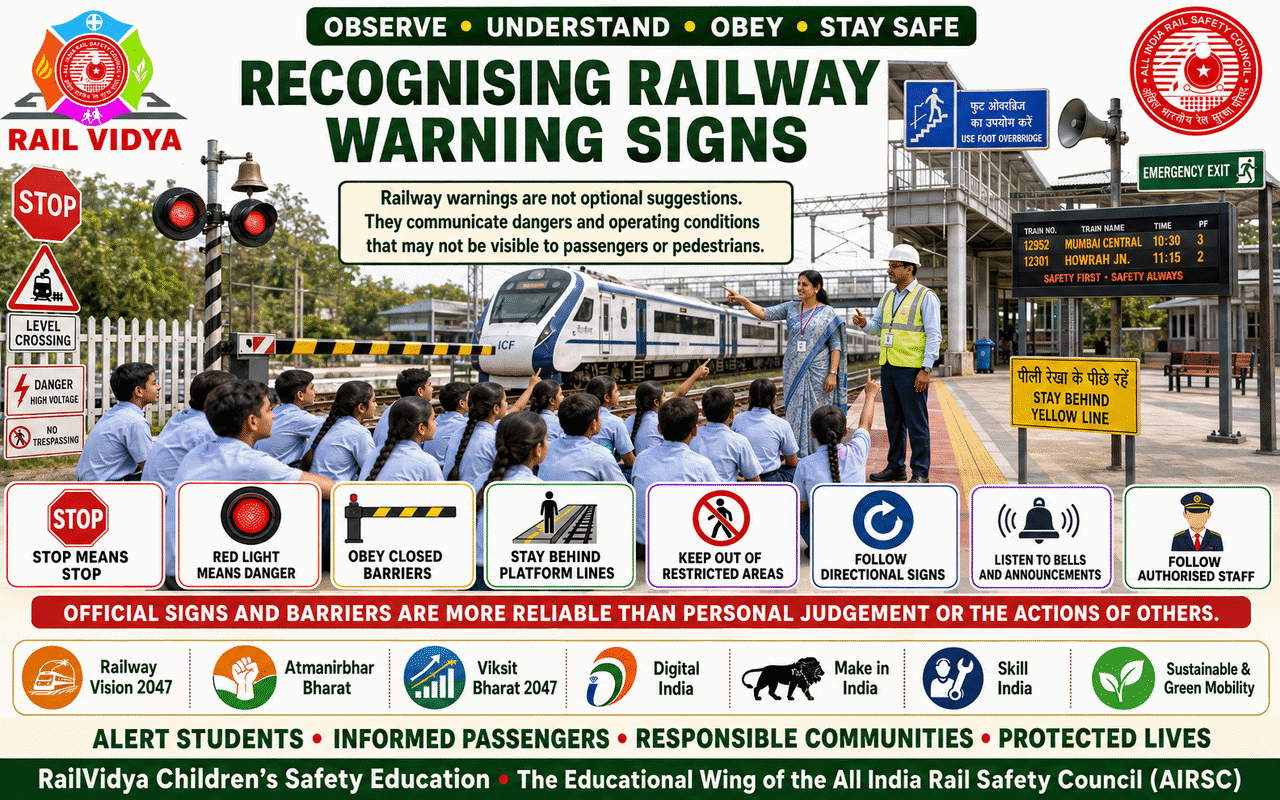
Recognising Railway Warning Signs teaches children to observe, understand and immediately obey authorised signs, signals, platform markings, barriers, lights, bells and public announcements. Through RailVidya, students learn to stay behind safety lines, use designated passenger routes, avoid restricted and high-voltage areas, wait until level-crossing warnings have fully stopped and seek authorised help whenever instructions are unclear. Respecting every railway warning is a simple but essential responsibility that prevents accidents and protects lives
Recognising Railway Warning Signs
Recognising railway warning signs is an essential part of children’s safety education and responsible railway travel. Warning signs, signals, markings, barriers, lights, bells and public announcements are designed to communicate danger, control movement and protect passengers and the public. Through RailVidya Children’s Safety Education, the educational wing of the All India Rail Safety Council (AIRSC), children are encouraged to observe, understand and obey every authorised railway warning without delay.
Railway warning signs are not optional suggestions. They communicate important instructions based on operational conditions that may not be visible to passengers or pedestrians. A track may appear clear while a train is approaching beyond a curve, behind a stationary train or from another direction. Children must understand that official signs and barriers provide more reliable safety guidance than personal judgement, assumptions or the behaviour of other people.
The colours, shapes, words and symbols used in railway environments help people recognise different types of information. Red commonly indicates prohibition, danger or the need to stop; yellow or amber warns people to remain cautious; and green may indicate that movement is permitted within a controlled system. However, railway signals are primarily intended for trained operational personnel. Children and members of the public must never interpret a train signal as personal permission to enter or cross a railway track.
Signs displaying instructions such as “Danger,” “Stop,” “No Entry,” “Do Not Cross,” “Keep Away,” “High Voltage,” “Restricted Area” or “Trespassing Prohibited” must always be obeyed. Children should never climb over fences, pass through locked gates or enter a location marked for authorised personnel only. These restrictions exist because the area may contain moving trains, electrical equipment, machinery, maintenance activity or other hazards.
Platform markings form an important part of passenger protection. Designated safety lines indicate the distance passengers should maintain from the platform edge, particularly when a train is approaching, passing through or departing. Children must remain well behind these lines and stay close to a responsible adult. Tactile paving is provided primarily to guide passengers with visual impairments and should be kept clear of luggage, play activities and unnecessary obstruction.
At level crossings, warning signs may include gates, barriers, red lights, bells, road markings and instructions from authorised personnel. When a warning activates or a barrier begins to close, everyone must stop and wait at a safe distance. Children must never pass beneath, around or through a closed barrier. They should proceed only after all warnings have stopped, the gate has been officially opened and passage is clearly authorised.
A train passing through a crossing does not automatically mean that the route is safe. A second train may be approaching from the opposite direction or on an adjacent line. Children must continue to wait until the complete warning system is deactivated. Patience at a crossing is not an inconvenience; it is a life-protecting decision.
Audible warnings are equally important. Train horns, crossing bells, whistles, alarms and public announcements may warn of an approaching train, platform alteration, evacuation or another operational condition. Children should immediately stop unnecessary conversation, remove headphones and listen carefully. If an announcement is unclear, they should ask a parent, teacher or authorised railway employee for guidance rather than making assumptions.
Directional signs help passengers locate platforms, exits, foot overbridges, subways, waiting areas, help desks, toilets and emergency facilities. Children should learn to follow these signs with a responsible adult and use only authorised passenger routes. If they reach the wrong platform or become confused, they must never cross the tracks or enter a restricted passage. The correct action is to seek help and follow the designated route.
Electrical-warning signs demand particular attention. Railway overhead wires and electrical installations may carry extremely high voltage. Children must never climb coaches, poles, signal structures or electrical equipment; fly kites near overhead wires; throw objects towards cables; or enter substations and fenced technical areas. Serious injury may occur even without direct contact under certain conditions.
Trackside and construction areas may contain temporary signs, cones, barricades or diversion notices. These warnings must receive the same respect as permanent signs. Children should never move barriers, enter excavation areas or take shortcuts through locations under maintenance. Temporary restrictions usually indicate changing conditions that require additional caution.
Emergency signs identify exits, evacuation routes, firefighting equipment, alarms and assembly points. Children should be introduced to these symbols in an age-appropriate manner so they can recognise them without interfering with the equipment. Emergency devices and exits must remain accessible and should be used only when genuinely required or when directed by authorised personnel.
Warning signs may use words, symbols or both to assist people from different language backgrounds. Children should be taught common railway-safety symbols through illustrations, games, quizzes and supervised observation. They should also understand an important rule: if a sign is unfamiliar, unclear or damaged, they should not guess its meaning. They must remain in a safe area and ask a responsible adult or authorised official for assistance.
Vandalising, covering, removing or ignoring warning signs can endanger many lives. Children should respect all railway signs and report damaged, hidden or unreadable warnings to a responsible adult or railway employee. Protecting safety information is part of respecting public property and contributing to the welfare of the community.
Digital displays and automated announcements are increasingly used in modern stations. These systems provide useful information, but children should distinguish between official railway communication and unverified information received through social media or other passengers. Journey decisions should be confirmed through authorised displays, announcements, railway staff or recognised passenger-information services.
Parents and teachers have an important role in teaching children how to recognise safety information. During supervised journeys, adults can point out platform lines, danger boards, emergency signs, authorised crossings and directional symbols. Schools can reinforce this knowledge through illustrated lessons, matching activities, role-play, poster competitions and safety-awareness programmes.
Adults must also demonstrate obedience to warning signs. When children see a parent cross against an active warning, pass under a closed barrier or enter a prohibited area, they may begin to consider that behaviour acceptable. Consistent adult example is essential to ensuring that children respect every warning, even when others do not.
As India advances towards intelligent signalling, modern stations, faster trains and digitally connected passenger services under Viksit Bharat 2047, the ability to recognise and follow safety information will become increasingly important. Technology can issue accurate warnings, but its protective value depends on people noticing, understanding and obeying them.
Through RailVidya, the All India Rail Safety Council seeks to develop a generation that treats railway warnings with attention, discipline and respect. A child who recognises a warning and responds correctly protects not only personal safety but also contributes to the wellbeing of families, passengers and the wider community.
The national message is clear: observe every sign, listen to every warning, follow authorised instructions and never enter an area marked as unsafe or restricted.
See the Sign • Understand the Warning • Follow the Instruction • Protect Every Life
© 2026 Dr.R.Padmanabhan. All Rights Reserved.
Founder Chairman — All India Rail Safety Council (AIRSC)
Promoting Railway Safety, Education and Public Awareness
Email: admin@railsafety.co.in | Website: www.railsafety.co.in / www.railsafety.in