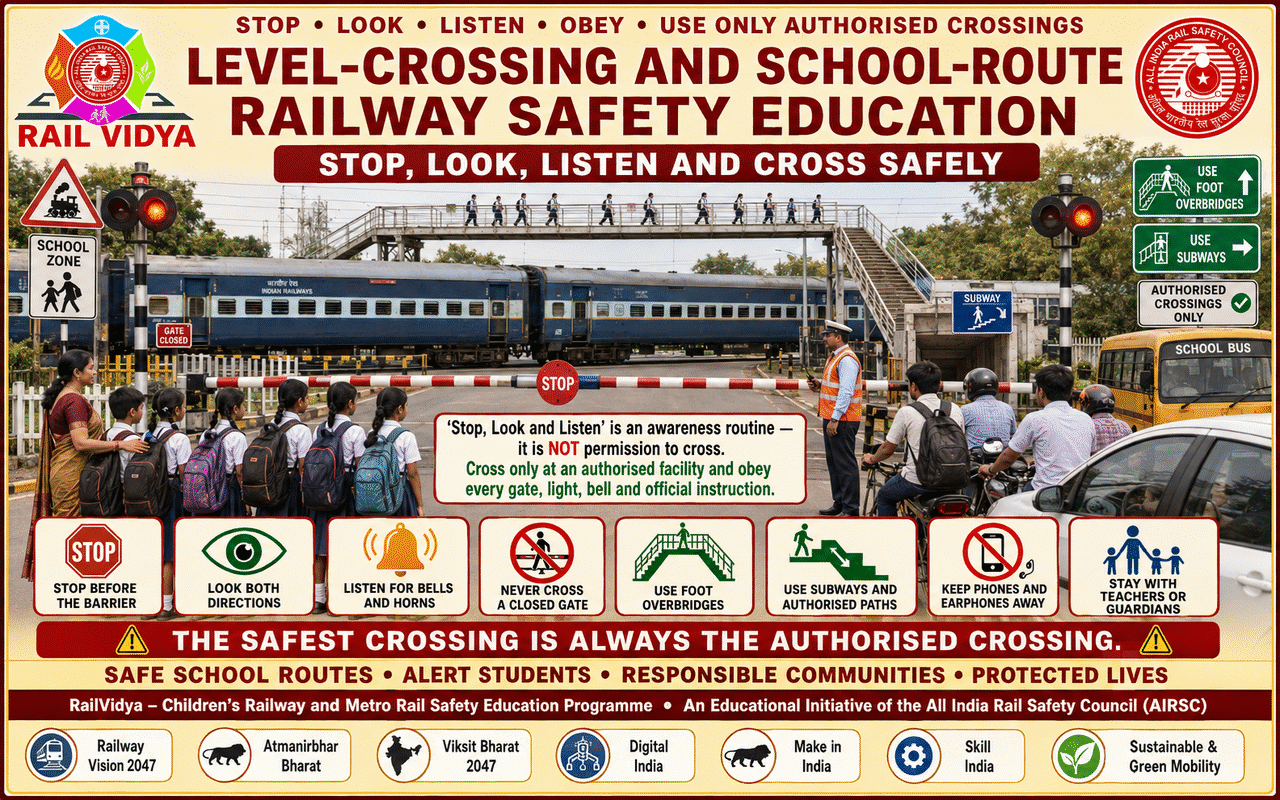
Level-Crossing and School-Route Railway Safety Education teaches children to use only authorised crossings, obey gates, barriers and warning signals, and never enter tracks or bypass a closed railway gate. Through RailVidya, students learn to follow planned school routes, remain attentive, keep mobile phones and headphones away near railway areas, avoid dangerous shortcuts and seek adult assistance when conditions are unsafe. Cooperation among schools, families, transport providers and communities is essential to ensure every child travels safely between home and school.
Level Crossing and School Route Railway Safety
Education
Stop, Look, Listen and Cross Safely
“Stop, Look and Listen” is an important awareness routine, but it does not by itself provide permission to cross a railway line. Children must cross only at an authorised level crossing, pedestrian crossing, foot overbridge, subway or another officially designated facility. Through RailVidya – Children’s Railway and Metro Rail Safety Education Programme, an educational initiative of the All India Rail Safety Council (AIRSC), children are taught that the safest crossing is always the authorised crossing and that every gate, barrier, warning light, bell and official instruction must be obeyed.
Before using an authorised crossing, children should stop at the designated safe point and remain behind any road marking, barrier or warning sign. They should look carefully in both directions and listen for train horns, bells, alarms and instructions from railway personnel. Headphones must be removed, mobile phones put away and conversations paused so that full attention remains on the railway environment.
A railway line that appears clear may still be unsafe. Trains can approach rapidly, may be hidden by curves, buildings, vegetation or stationary vehicles, and can move on any available track. A second train may follow the first or approach from the opposite direction. Children must never assume that the crossing is safe merely because one train has passed.
Children should cross only when the barrier is fully open, active warnings have stopped and passage is officially permitted. They should walk directly across using the designated path without running, stopping, playing or taking photographs. They must never remain on the tracks or return for a dropped item.
Where a foot overbridge, subway, road overbridge or underpass is available, it should be used instead of entering the track level. Younger children should cross only under appropriate adult supervision. If conditions are unclear or a safety system appears damaged, children should remain away and seek authorised assistance.
The national message is clear: stop at the safe point, observe every warning and cross only through an authorised facility when passage is officially permitted.
Stop Safely • Look Both Ways • Listen Carefully • Cross Only When Authorised
Understanding Railway Gates and Warning Signals
Railway gates and warning systems are life-protecting controls designed to separate trains from pedestrians, cyclists and road vehicles at level crossings. They may include barriers, gates, red warning lights, bells, road markings, signs and instructions from authorised personnel. Children should understand that these systems communicate an operational danger that may not yet be visible.
When a barrier begins to close or a warning activates, all road users and pedestrians must stop at a safe distance. No one should attempt to cross before the gate closes completely, even if the train appears far away. The warning indicates that train movement has priority and that entering the crossing is unsafe.
A closed gate or active red light must be obeyed without exception. Bells and flashing lights may remain active when more than one train is approaching or while the crossing continues to be protected. Children must wait until the warning has ended, the gate is fully open and passage is officially permitted.
Railway signals positioned beside tracks are generally intended for trained railway personnel and train operations. Children and members of the public must not interpret a green railway signal as personal permission to enter or cross a track. Public crossing decisions must be based only on authorised pedestrian facilities, level-crossing controls and official instructions.
Children must never touch, damage or interfere with gates, lights, bells, signs, signal equipment or control mechanisms. These systems protect many lives, and any defect should be reported from a safe location to a responsible adult or authorised railway official.
Schools and families can strengthen understanding by teaching children to recognise common public-facing warnings while making clear that signal designs and procedures may vary. Only currently verified guidance from the relevant railway authority should be used.
As India modernises railway infrastructure under Viksit Bharat 2047, public cooperation remains essential. Advanced warning systems can protect lives only when every person observes and obeys them.
See the Warning • Stop at the Barrier • Follow Official Instructions • Wait Until Fully Open
Never Cross Under or Around a Closed Railway Gate
A closed railway gate is an absolute warning that the crossing is not safe. It must never be treated as an inconvenience or obstacle to be bypassed. Children, pedestrians, cyclists and vehicle users must remain behind the barrier until it is fully opened and all active warnings have ended.
Passing under, around or between closed barriers can place a person directly in the path of an approaching train. Trains may be moving faster than they appear and require a considerable distance to stop. A train driver cannot turn away from a person on the track and may be unable to prevent an accident even after applying emergency brakes.
After one train passes, the crossing may remain closed because another train is approaching on a neighbouring line or from the opposite direction. Children must never follow a pedestrian, cyclist or driver who begins crossing illegally. Unsafe behaviour does not become acceptable simply because others are doing it.
Children should wait well behind the gate and remain away from the track, barrier mechanism and roadside traffic. They must not climb, swing upon or touch the barrier. Bicycles should be kept under control, and school bags or clothing should not extend into the crossing area.
If the gate remains closed for an extended period, children should continue waiting or use another authorised route under adult guidance. They should never become impatient, take a shortcut or cross through a gap in fencing. A delay can be managed; a preventable tragedy cannot be reversed.
Parents and teachers must demonstrate consistent obedience. Adults who bypass gates send a dangerous message to children. Every responsible adult should reinforce the principle that safety always takes priority over speed and convenience.
Through RailVidya, AIRSC seeks to establish zero tolerance for unsafe level-crossing behaviour. A closed gate means only one thing: stop, stay back and wait.
Gate Closed—Do Not Cross • Never Go Under • Never Go Around • Wait Safely
Safe Crossing Practices for Schoolchildren
Schoolchildren may encounter railway crossings while travelling on foot, by bicycle, in school vehicles or through communities located near railway lines. Safe route planning, adult supervision and repeated education are therefore essential. Every school journey should prioritise authorised crossings and avoid railway tracks, yards, bridges, tunnels and informal shortcuts.
Schools and families should identify the safest available route before children begin travelling independently. Foot overbridges, subways, road overbridges and officially designated crossings should always be preferred. A shorter unauthorised route across tracks must never be accepted as a normal school path.
Younger children should use level crossings only under responsible adult supervision. They should walk rather than run, remain together and follow the gate, warning signals and authorised personnel. School groups must not crowd near the barrier or spill into the roadway while waiting.
Children travelling by bicycle should dismount where official signs, local conditions or supervision require it and cross only when passage is fully authorised. They should never cycle around a closed gate or attempt to ride across a track hurriedly. Wheels can slip or become trapped in track grooves, especially when approached at an unsafe angle.
School buses and other vehicles must stop and wait in accordance with applicable traffic and crossing controls. Children should remain seated and should never open doors, lean outside or distract the driver near a railway crossing. Boarding and alighting should take place only at planned, safe locations away from the track area.
Schools located near railway infrastructure should conduct periodic route-safety reviews, assemblies, classroom lessons and community-awareness activities. Parents, transport providers, local authorities and relevant railway representatives should cooperate to identify hazards and discourage habitual trespassing.
Children must know what to do if a regular route becomes blocked or unsafe. They should not create a new shortcut across tracks. Instead, they should return to a safe location, contact a responsible adult and use an approved alternative route.
RailVidya seeks to ensure that every journey between home and school supports learning without exposing children to avoidable risk. Safe routes, responsible supervision and consistent behaviour can protect students and strengthen railway-adjacent communities.
Choose an Authorised Route • Stay with Your Group • Obey Every Warning • Reach School Safely
Road–School–Rail Safety Awareness
Road–School–Rail Safety Awareness is an integrated approach to protecting children throughout the complete journey between home, school and public-transport facilities. A child may encounter roads, bus stops, railway crossings, stations and pedestrian routes during one journey. Safety education must therefore connect these environments rather than treating each risk separately.
A safe school journey begins with planned routes, responsible supervision and sufficient travel time. Children should use pavements, pedestrian crossings, foot overbridges, subways and authorised railway facilities. They must avoid informal paths across tracks, gaps in fences, railway yards and other restricted areas.
Traffic and railway risks can overlap near level crossings. Road congestion, impatient drivers, bicycles, school buses and pedestrians may gather close to barriers. Children should wait in a protected area, remain aware of road vehicles and never stand between a closed gate and the railway track.
Schools should map the routes commonly used by students and identify railway crossings, high-traffic roads, poorly controlled pedestrian areas and other hazards. Safety reviews should involve parents, school-transport providers, community representatives and relevant public authorities. Identified concerns should be reported through appropriate official channels.
School transport drivers carry an important duty of care. Vehicles should follow authorised routes, obey traffic and railway warnings and stop only at safe boarding points. Drivers must never attempt to overtake queues at a crossing, manoeuvre around a closed barrier or stop a vehicle where children could enter the track area.
Teachers can integrate road and rail safety into assemblies, classroom activities, safety clubs, route-mapping exercises and practical demonstrations. Children should learn how to interpret public-facing signs, seek authorised assistance, report unsafe conditions and resist peer pressure to take shortcuts.
Parents should practise the same behaviours taught in school. Walking an approved route with children, putting phones away near crossings and obeying every gate reinforces the message that safety is a shared family responsibility.
Special attention should be given to railway-adjacent schools and communities where repeated exposure can make danger appear ordinary. Familiarity never makes railway tracks safe. Continuous awareness is necessary to replace normalised unsafe behaviour with responsible alternatives.
As India advances towards safer roads, modern railways and integrated public transport under Viksit Bharat 2047, child-safety planning must connect education, infrastructure and community participation. Every child should be able to reach school and return home through a journey designed around the protection of life.
Through RailVidya, AIRSC seeks to build a coordinated national culture in which schools, families, transport providers and communities share responsibility for children’s mobility. A safe route to education is not merely a transport requirement—it is an essential commitment to the nation’s future.
Safe Road • Safe Crossing • Safe School Journey • Every Child Protected
© 2026 Dr.R.Padmanabhan. All Rights Reserved.
Chairman — All India Rail Safety Council (AIRSC)
Promoting Railway Safety, Education and Public Awareness
Email: admin@railsafety.co.in | Website: www.railsafety.co.in/ www.railsafety.in/ www.airsc.in