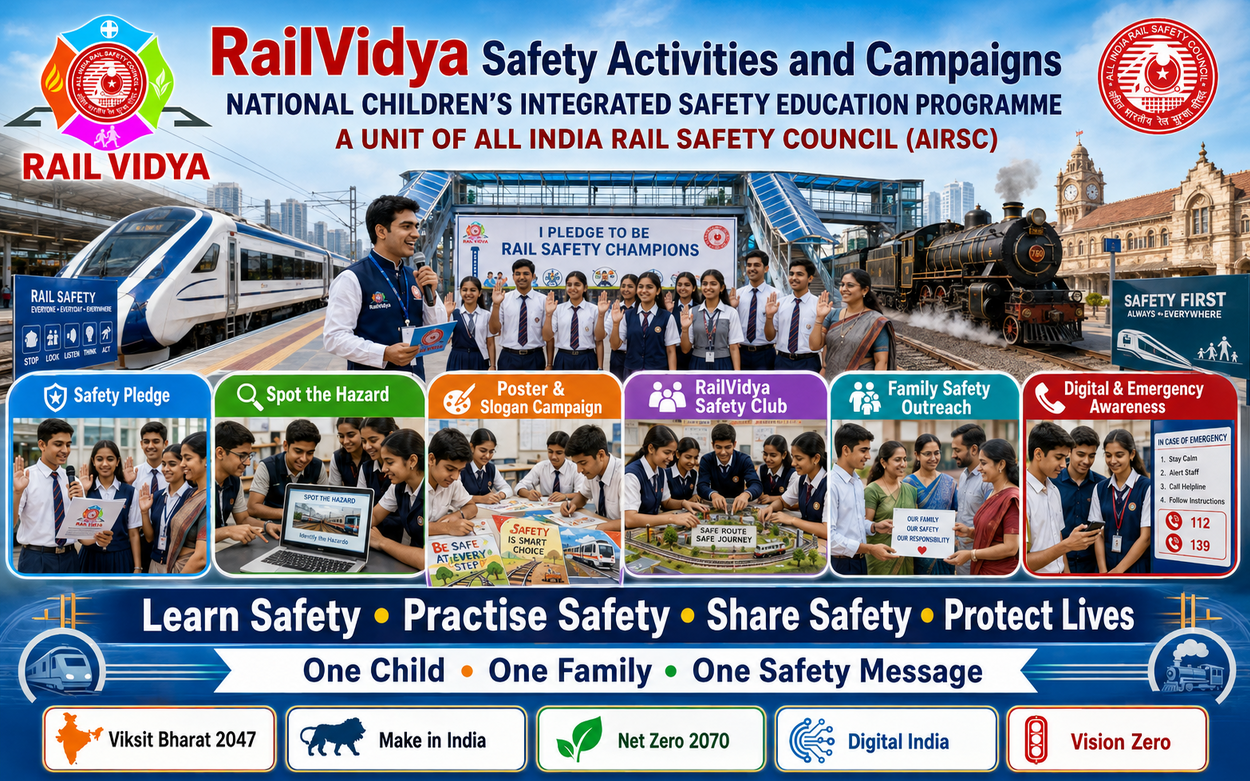
Safety Activities and Campaigns RailVidya Safety Activities and Campaigns, an initiative of the All India Rail Safety Council (AIRSC), transforms railway and metro-safety education into engaging, practical experiences for children. Through safety pledges, demonstrations, quizzes, creative competitions, Safety Clubs, digital learning and family outreach, the programme develops responsible habits and empowers students as Young Railway and Metro Safety Ambassadors. Learn Safety • Practise Safety • Share Safety • Protect Lives
Safety Activities and Campaigns
The RailVidya Safety Activities and Campaigns constitute a dynamic national education, public-awareness and community-participation initiative of RailVidya – Children’s Railway and Metro Rail Safety Education Programme, the educational wing of the All India Rail Safety Council (AIRSC). The initiative is designed to transform essential railway and metro-safety knowledge into practical understanding, responsible behaviour and sustained public participation among children, schools, families and communities.
Safety education becomes most effective when children are given opportunities to learn, practise, create and communicate. RailVidya therefore moves beyond conventional classroom instruction by combining interactive activities, creative competitions, demonstrations, digital learning and community campaigns. This approach enables children to understand why safety rules are important, how risks arise and what responsible action should be taken in real-life situations.
The activities focus on essential railway-safety principles, including never walking or playing on railway tracks, avoiding unauthorised shortcuts, using foot overbridges and subways, obeying level-crossing gates and warning systems, remaining behind platform safety lines and never boarding or alighting from a moving train. Children also learn about multiple-track risks, overhead electrical hazards, safe school routes and the dangers of distraction near railway infrastructure.
Metro-safety activities address responsible behaviour at stations and inside trains. Children learn to allow passengers to exit before boarding, mind the gap, keep away from automatic doors, respect platform screen doors and use escalators, lifts, stairways and ticket gates safely. Activities also promote the correct use of smart cards and digital tickets, respect for reserved seats and accessible facilities, and calm responses during service disruptions or emergencies.
RailVidya activities are designed to be age-appropriate, positive and participatory. Stories, cartoons, role-play, quizzes, puzzles, colouring sheets, model-making, poster design and scenario-based discussions help younger learners understand safety without unnecessary fear. Older students may participate in risk-identification exercises, debates, presentations, digital-content creation and community-awareness projects that develop leadership and informed decision-making.
The RailVidya Safety Pledge can serve as a unifying feature of school programmes and public campaigns. By taking the pledge, students affirm their commitment to avoid railway tracks, follow official instructions, use authorised crossings, travel responsibly and share accurate safety messages. The pledge should be reinforced through practical action so that it becomes a behavioural commitment rather than a ceremonial statement.
Poster, essay, slogan, drawing and short-video competitions can encourage children to express railway and metro-safety messages creatively. Competition themes may include “Railway Tracks Are Not Playgrounds,” “Safe Child–Safe Railway–Safe India,” “Mind the Gap,” “Never Block Metro Doors,” “Stop, Look, Listen and Cross Only When Authorised” and “My Safety–My Responsibility.” Entries should communicate accurate guidance and must never require children to enter operational or restricted railway areas.
Demonstrations conducted by authorised railway, metro and safety professionals can strengthen practical understanding. Students may be shown how to recognise public-facing warning signs, stand safely on platforms, use station facilities and identify authorised assistance points. Demonstrations must take place in controlled environments and should never expose participants to operational tracks, electrical systems or moving equipment.
Safety games and quizzes provide valuable opportunities to assess understanding while maintaining engagement. “Spot the Hazard,” “Choose the Safe Route,” “Match the Warning Sign” and “What Would You Do?” activities can help children apply knowledge to realistic scenarios. The emphasis should remain on learning and improvement rather than competition alone.
The RailVidya Safety Club can coordinate monthly activities within participating schools. Club members may organise assembly messages, poster exhibitions, quizzes, route-mapping exercises, peer-learning sessions and awareness displays. Students who demonstrate sustained participation may be recognised as Young Railway and Metro Safety Ambassadors and encouraged to share verified messages with their families and neighbourhoods.
The principle of “One Child–One Family–One Safety Message” extends school-based education into the community. Children may take home illustrated cards, safety checklists and family discussion activities. A child who reminds family members to use an authorised crossing, avoid mobile-phone distraction or wait behind a closed gate becomes an active contributor to accident prevention.
Community campaigns are particularly important in areas located near railway tracks, stations and level crossings. RailVidya may work with schools, parents, community organisations and competent authorities to promote authorised routes and discourage trespassing. Public activities should be conducted only in safe, approved locations and must never obstruct passengers, traffic or railway operations.
The National Railway and Metro Safety Education Week can bring together school assemblies, expert sessions, exhibitions, safety pledges, digital lessons and public-awareness events under a coordinated annual campaign. A focused national observance can generate wider attention while encouraging participating schools to continue safety education throughout the year.
Digital campaigns can expand the initiative’s reach through animations, comics, short educational videos, interactive quizzes and resources in Indian languages. Every digital message should be accurate, inclusive and child-appropriate. Content should avoid sensational accident imagery and instead emphasise prevention, calm decision-making and positive safety behaviour.
Responsible digital conduct should itself form a campaign theme. Children must understand that mobile phones, headphones, selfies and online challenges can create serious risks near tracks, platforms, crossings and moving trains. RailVidya should encourage students to reject unsafe content and use digital creativity only in supervised, non-operational locations.
Parents, teachers and guardians are essential partners in every campaign. Children learn from the behaviour they observe; adults must therefore use authorised crossings, respect station markings, avoid rushing and follow all official instructions. Parent-awareness sessions can help align household practices with the safety lessons taught at school.
Campaigns should promote inclusion and accessibility. Materials may be adapted for different ages, languages, learning abilities and regional transport environments. Activities should represent children from diverse communities and encourage respect for passengers with disabilities, senior citizens and others requiring additional support.
Emergency-awareness activities can teach children to remain calm, stay with responsible adults, follow official announcements and seek assistance from authorised personnel. Children should learn never to enter tracks, attempt an unsafe rescue or touch an unattended object. Only officially verified and currently valid emergency information should be displayed.
Programme effectiveness may be reviewed through participation records, quizzes, student reflections, teacher observations, family feedback and follow-up activities. The objective is to understand whether the campaign has improved risk recognition and behaviour, rather than measuring success only by the number of events conducted.
Responsible partnerships can strengthen national reach. Schools, educational institutions, transport organisations, safety professionals, civil-society groups and community representatives may contribute knowledge and resources within a clearly governed framework. All activities should maintain child protection, operational safety, factual accuracy and institutional transparency.
As India advances towards modern railways, expanding metro networks and integrated public transport under Viksit Bharat 2047, safety awareness must grow alongside technological development. Infrastructure can reduce risk, but lasting protection requires informed citizens who understand and respect the systems created for their safety.
Through its Safety Activities and Campaigns, RailVidya seeks to make every child an active participant in building safer mobility. A story can create understanding, an activity can develop a habit, and a child’s message can influence an entire family. Together, these actions can contribute to the national aspiration of Vision Zero, under which every preventable death and serious injury is considered unacceptable.
Learn Safety • Practise Safety • Share Safety • Protect Lives
© 2026 Dr.R.Padmanabhan. All Rights Reserved.
Founder Chairman — All India Rail Safety Council (AIRSC)
Promoting Railway Safety, Education and Public Awareness
Email: admin@railsafety.co.in | Website: www.railsafety.co.in / www.railsafety.in